The Gospel of John begins with a powerful expression about our Saviour Jesus Christ: ‘In the beginning was the Word, and the Word was with God, and the Word was God.’ In the original Greek, the word “Word” is Logos, which can mean speech, word, meaning, thought, reason, principle, rule, relation, doctrine or law. The English word logic is also the derivation of the Greek word logos. The Word of God is therefore not in conflict with human reason or logic, for Jesus Christ is the personification of reason, just as He is the personification of love (1 John 4:8). I quote from Wikipedia on the historical meaning of logos in ancient Greece:
In philosophy, the Greek word logos has been used in various different senses at different times. Heraclitus of Ephesus (535-475 BC) used the Greek word to describe the ultimate origin of the universe. Heraclitus used the word to refer to the organizing principle of reality that governs everything and creates the connection between everything. In this context, the word means, above all, reason. Another sense in which Heraclitus uses the word is natural law… In the time of Socrates, Plato and Aristotle, the Greek word logos was used to describe the human use of reason. According to Plato, reality can be understood by reason. Therefore, reality is also ordered according to the principles of reason. The Stoic (c. 300 BC) philosophers followed Heraclitus in their interpretation.
The Stoics emphasised the role of the word as the organising principle of the universe and sometimes identified it with the divine. It was a rational divine power and a principle of reason (nous). It governed nature and man had to live his life according to it. According to Aristotle, people can be convinced in three different ways. These are appeal to the emotions (pathos), appeal to the nature of the speaker (ethos) and appeal to the content of speech and reason (logos). In this distinction made by Aristotle, the word logos refers to reason and the content of speech and arguments. Today, the Aristotelian distinction is still used in rhetoric. All arguments used by a speaker can be included in the field of reasoned argumentation. Reasoned arguments can also include mathematical models, opinion polls and other scientific knowledge.
I just did the Myers-Briggs Type Indicator Test, based on the research of Carl Jung, the Swiss founder of analytical psychology, whose teachings have had a great influence on Canadian psychologist Jordan Peterson, who often speaks sympathetically about the Bible, Christianity and conservative Judeo-Christian values. The test can be taken for free in English on this website. I recommend the test because it helps us to understand our own unique personality, which God created each human being to be, with our individual strengths and weaknesses. That doesn’t mean that we don’t all have character flaws, or wrong attitudes/habits that we should grow out of. But some of our so-called “character flaws” may also be influenced by our own individual personality traits. For example, most people understand that some of us are extroverts, while others are more or less introverts.
Extroverts often enjoy being around other people and they get their energy from lively social interaction, while introverts are more comfortable being alone with their own thoughts and get exhausted easily in social situations. However, introverts also enjoy being with other people when they feel that the social interaction is genuine and profound. But social situations that require superficial and mundane “small talk” skills make introverts feel very akward and uncomfortable. I think most of us Finns are innately a bit introverted.
I have known for years that I am much more of an introvert by nature than an extrovert by nature. It’s enough for me to know that I have a few good friends to whom I can open up about sensitive and embarrassing things when necessary, but I have no compulsive need to seek out social situations, or to be in constant conversation even with my closest friends or family members. But when I do connect with someone, I tend to be very open, genuine and transparent with them. But even though I am an introvert, I would be lying if I said I have never suffered from loneliness. But it’s also often the case that a person can feel much lonelier in the company of others, especially if they get the feeling that they don’t belong.
This is one reason why introverts avoid social interactions and prefer to keep to themselves. They spend so much of their time in their own heads, and feel that their interests are so far from the most mundane topics of conversation of so-called “normal” people, that they prefer to remain silent and only open their mouths when they feel someone is on the same wavelength with their thoughts. When the subject turns to, say, the weather or sport, the introvert may pretend to be interested so as not to seem too rude or aloof, but deep down he or she hates pretending, as well as not knowing enough about a subject of discussion.
I did the Myers-Briggs personality test first in English and a second time in Finnish. In the English version, the results showed me to be 96% introverted, but in the Finnish version I answered some questions slightly differently, and my introversion dropped to 85%. However, the ultimate results were the same in both. It says I am an INTP, or logician. INTP stands for “Introvert, iNtuitive, Thinking and Perceiving. I’m certainly in pretty good company, since the test says that “some of the most influential philosophers and scientists of all time have been Logicians”. They include names such as Rene Descartes, Isaac Newton and Albert Einstein. The 16personalities website includes the following characterisation of the personalities of logicians:
Logicians pride themselves on their unique perspectives and vigorous intellect. They can’t help but puzzle over the mysteries of the universe – which may explain why some of the most influential philosophers and scientists of all time have been Logicians. This personality type is fairly rare, but with their creativity and inventiveness, Logicians aren’t afraid to stand out from the crowd. Logicians often lose themselves in thought – which isn’t necessarily a bad thing. People with this personality type hardly ever stop thinking. From the moment they wake up, their minds buzz with ideas, questions, and insights. At times, they may even find themselves conducting full-fledged debates in their own heads.
From the outside, Logicians may seem to live in a never-ending daydream. They have a reputation for being pensive, detached, and a bit reserved. That is, until they try to train all of their mental energy on the moment or the person at hand, which can be a bit uncomfortable for everyone. But regardless of which mode they’re in, Logicians are Introverts and tend to get tired out by extensive socializing. After a long day, they crave time alone to consult their own thoughts. But it would be a mistake to think that Logicians are unfriendly or uptight. When they connect with someone who can match their mental energy, these personalities absolutely light up, leaping from one thought to another. Few things energize them like the opportunity to swap ideas or enjoy a lively debate with another curious, inquiring soul.
Logicians love to analyze patterns. Without necessarily knowing how they do it, people with this personality type often have a Sherlock Holmes–like knack for spotting discrepancies and irregularities. In other words, it’s a bad idea to lie to them.
The following description of the personality of logicians on another website is at pretty much in line with my own personality:
INTPs are only around 3-5% of the population. The typical INTP is quiet, reserved, flexible and adaptable. They have a phenomenal ability to immerse themselves in solving problems that interest them. They are sceptical, sometimes even critical and always highly analytical. The INTP prides himself on his inventiveness and his original way of thinking and observing. He is considered the most logical of personality types. Although the constantly reflective INTP may seem absent-minded to some, those closest to him know that in familiar company he is the nicest and friendliest of all. In the company of strangers, this introvert is quiet and can even be very shy… Because the INTP is constantly re-evaluating his logical conclusions, he is constantly worried that he has missed something, that he is wrong, that he has overlooked something vital. This personality type is not interested in mundane and routine maintenance tasks – and it would be a pity to trap him in one, because the INTP serves the world best when he can focus on finding unique and creative solutions to problems.
As I have often said, my school performance was very poor, as the grades of my elementary school’s graduation certificate were not high enough to qualify me for even upper secondary school for further studies. So how could such a blockhead belong to a club of logicians renowned for their ” vigorous intellect”? I have never considered myself to have a particularly sharp mind, but my poor grades at primary school were perhaps more a reflection of a lack of motivation than of intelligence. At least according to an IQ test I took a few years ago (though not Mensa’s official IQ test), I scored 120. So not quite Einstein’s level (estimated at 160), but above average (100).
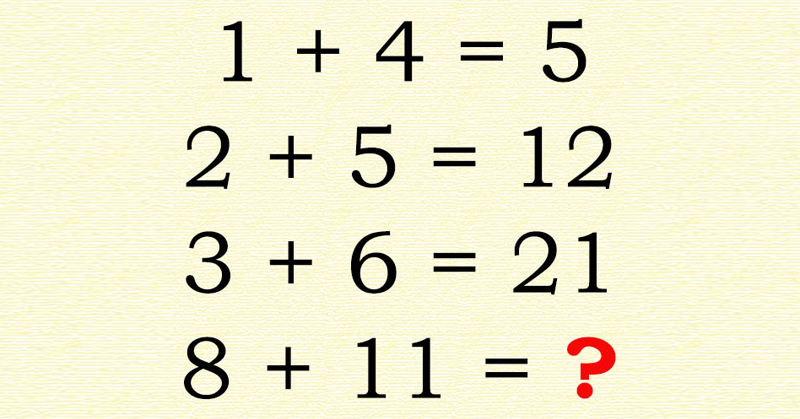
Beside is a fun mathematical puzzle that supposedly only people with high IQ can solve (I’ll make it easier: two possible answers, only one of which is correct). The IQ tests are a bit one-sided, though, as they mainly measure only visual and mathematical reasoning ability. They tell us nothing about a person’s emotional intelligence or artistic/musical intelligence. It should also be understood that knowledge, intelligence, and wisdom are three completely different things. A person can be stupid (not wise) even if he has a very high IQ. Or a person can have a lot of knowledge about various things, but no intelligence or wisdom. When Daniel predicted that knowledge shall increase towards the end of time (Daniel 12:4), it does not always automatically lead to an increase in intelligence or wisdom. Humanity’s scientific knowledge has increased exponentially over the last 500 years, but man today is no more intelligent or wise than he was in the Middle Ages.
But if logic and thinking “outside the box” are strengths of our logicians, we also have our weaknesses, one of which is laziness or lack of motivation. Because logicians hate boring routines, their way of working is also often very impulsive. They may be idle for long periods of time, until one moment they put all their energy into a project that they get excited about on the spur of the moment. For example, I wrote my 356-page Finnish book in just three weeks and my 424-page English in just over seven weeks. Often they also leave many projects unfinished because they are perfectionists (I have many examples of this too in my own case). As the 16personalities website says about this strange personality type:
This “analysis paralysis” can affect multiple areas of Logicians’ lives. People with this personality type can overthink even the smallest of decisions. This makes them feel ineffective and stuck, so exhausted by the endless parade of thoughts in their mind that they struggle to get things done. The good news is that Logicians don’t have to stay stuck for long. Their unique strengths include everything they need to pull themselves out of the ruts that they occasionally fall into. By leveraging their creativity and their open-mindedness, Logicians can reach their full potential – both as thinkers and as happy, well-rounded people.
So if readers of my blog sometimes wonder why my blogging pace is so erratic or why I sometimes have long breaks from publishing new posts or videos, I hope this post will help you understand me a little better. I’m just a logician stuck in my own head in an endless daydream. And believe me, lack of motivation is something that bothers me too. I even wrote this post just to get something done.
 Author & blogger Samuel Tuominen’s archives
Leave a comment