Listen to the article:
I ended my previous long blog with the following epilogue: ‘While I may have been wrong about 2023 being the year of the Vatican’s destruction, I was not wrong about its historical and prophetic significance when we note that it was the year Charles III was anointed king. About the same time with Charles’ coronation, the United Kingdom, under His Majesty’s administration, also made a seven-year treaty with Israel, as I wrote about in my blog back in April. I wrote back then that I did not believe that this treaty was yet the starting shot for the 70th week of Daniel 9. If that would be the case, then its midpoint would have to fall in September 2026. If there is not a third temple in Jerusalem by that time for Charles to enter, or if there is not a global government and the mark of the beast in the world by that time, then we cannot yet be in the 70th week. Besides, I believe the rapture of the church will happen before the 70th week.”
I continued, “I believe the opening of the first six seals of Revelation will take place before the rapture of the church and the 70th week of Daniel 9. Thus, even if the beginning of the seven-year tribulation period were 10 years away, the events of the first six seals should take place within the next 10 years. Likewise, the appearance/revelation of the Antichrist mentioned by Paul in 2 Thessalonians 2:3 should precede the rapture of the church and the 70th week of Daniel 9. So, for example, Charles’ coronation in May 5th could already have been the moment of the opening of the first seal, when “a crown was given to him, and he went out conquering and to conquer.” So from that moment onwards Charles would begin his diplomatic conquests, culminating in the world’s rulers ‘yielding their power and authority to the beast‘.”
Content
- Sami Lahti’s chronology versus pre-mid- and post-tribulationism
- God will save the church from wrath, not from tribulation
- The church is not going to be in tribulation, but is already
- The pre-wrath rapture in Revelation 7:9
- The correct timing of the time of wrath in Revelation
- Chronology of Samuel versus chronology of Sami
- The time of serenity on earth
- Simultaneity of the 7 trumpets and the 7 bowls of wrath
- Incorrect timing of two witnesses
- Total length of seals, trumpets and bowls in years
- Clarification again on the Thessalonians
- Footnotes
Sami Lahti’s chronology versus pre-mid- and post-tribulationism
This article is perhaps a repetition of my old arguments. But I was inspired by a new 10-part series by my Facebook friend Sami Lahti. I already mentioned Sami Lahti’s blog in my November blog. I got to know the man mainly through our discussions about AI, but he also has an extensive output of eschatological writings, and I agree more than disagree with his views. Our friendly interaction has been facilitated by the fact that he does not regard my own ideas with a stupefying hostility, but rather with intellectual curiosity, and considers my idea of Charles as the final Antichrist to be an interesting and intriguing possibility. I would hope for a similar attitude from many other Christians, but I understand the debate around biblical eschatology is an area that arouses strong opinions and emotions with many of us.
I encourage the reader to read Sami’s 10-part series of articles for themselves, as I will not repeat his arguments in detail in my own text. I will, however, comment on the series where I agreed and disagreed with Sami’s views. At the heart of Sami’s ideas seems to be that Revelation is not just an allegorical text, but a prophecy of concrete events in the near future, intended to be understood in a precise chronological light, and that a chronological understanding of it helps us to find there the time of wrath and the right time for the rapture in the end-time calendar. I have already been introduced to quite a variety of thinking in interpreting the Book of Revelation, so Sam’s views in this area were refreshingly different, rather than just repeating the views of the older schools of thought.
In short: In Sami’s view, Revelation is a narrative that proceeds in a completely chronological order where the seven seals are followed by seven trumpets and the seven trumpets are followed by seven bowls of wrath. These in turn are followed by the return of Jesus Christ in the clouds of heaven on His white horse accompanied by the army of His redeemed saints. Then begins the millennial kingdom where Satan is bound for a thousand years in Hades and this in turn is followed by Satan’s final rebellion against God’s saints after he is released, the judgment of Satan and his followers in the unquenchable lake of fire, the creation of the new earth and new heavens and the descent of the New Jerusalem to the earth.
After return of Jesus, all premillenialists agree on this chronology. There are also various overlapping explanations among premillenialists for the seals, trumpets and bowls, which Lahti criticizes in his article. Then there are the terms that have spread from the English language, such as pre-tribulation, mid-tribulation and post-tribulation. Sami’s series of teachings cannot really be categorised under any of the above, since ‘tribulation’ in this context refers mainly to the concept of the seven-year tribulation period, which spread with dispensationalism and which he slightly criticizes and clarifies in his text. The prefixes pre-, mid-. and post- refer to the concept of the rapture of the church and its timing in relation to this seven-year tribulation.
All three of these schools of thought are based on the premise that the seven-year tribulation would begin with the opening of the first seal in Revelation. Hence, the rapture also tends to be timed accordingly in those different views. Pre-tribulationists usually date it to the ascension of John in Revelation 4:1, mid-tribulationists to the blowing of the seventh trumpet or the ascension of the two witnesses in Revelation 11:11-15, and post-tribulationists to the harvest in Revelation 14:15 or the first resurrection in Revelation 20:5. Both my own eschatological understanding and that of Sami differ from these premises.
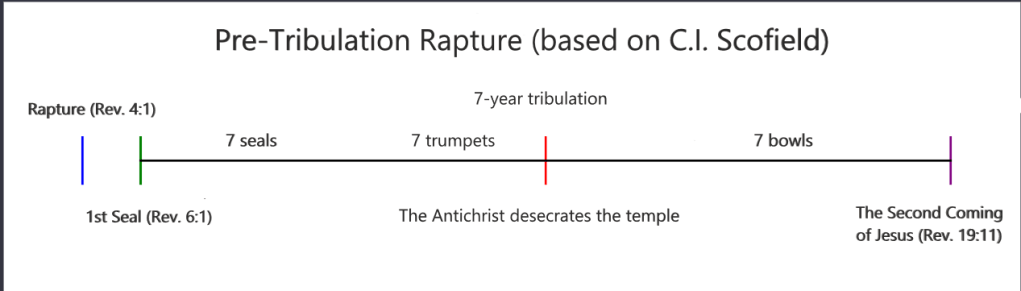

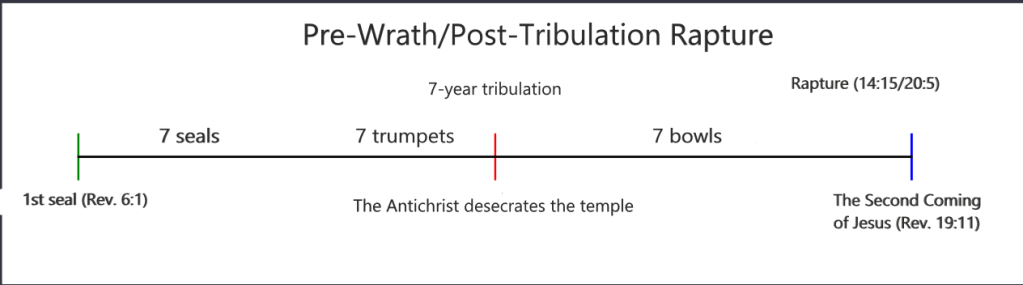
In Sami’s chronology, the order of events was as follows:

I sent the chart above to Sami Lahti himself for review and he confirmed that it correctly represents his views. So in this chronology, the rapture occurs before that seven-year period, as the pre-tribulationists already teach. But the most significant difference from the standard version1 of pre-tribulationism described above in Sam’s chronology is that this seven-year period does not begin when the Lamb opens the first seal in Revelation 6:1, but only after the seven seals and six trumpets.2And although the rapture occurs before that seven-year period, it does not occur at John’s ascension in Revelation 4:1 before the time of the seals, trumpets and bowls, but only after the first six seals in Revelation 7:93
God will save the church from wrath, not from tribulation
Sam’s chronology also stressed that the church will be saved from the coming wrath but not from the coming tribulation. At this point, many might confuse Sami’s views with either mid-tribulationism or pre-wrath doctrine, which is a kind of intermediate between mid- and post-tribulationism.4 However, chronologically, Sam’s views are closer to pre-tribulationism than mid- or post-tribulationism. I quote his text below:
The Great Tribulation is the period of time that the church faces and is synonymous with the word persecution. The church in chapter 7 comes out of the great tribulation and this is not to be confused with this so-called American style time of wrath. So when I say that in Revelation the rapture occurs at the end of the great tribulation before the time of wrath, I mean that the rapture occurs more than seven years before the return of Jesus, but that the church will be in great tribulation or persecution. At this point, usually both the pre-tribulation and post-tribulation schools of thought cry out “read your Bible better” and raise a slew of ad hominem arguments or other accusations.
So I do not support either of these traditional schools of thought (nor the mid-tribulation model), but I do support a detailed study of the word of Revelation. I believe it holds all the keys to unlocking this mystery. Once these two terms (tribulation and wrath) get their right explanation, many of the end-time events in the Bible will fall into place and many of the seemingly contradictory issues will be removed. Now that these terms are clear, we can next examine how long the time of tribulation is and how long the time of wrath is.5
On this point I agree completely with Sami, as I myself do not either subscribe to pre-, mid-, or post-tribulationist views (nor do I subscribe to the pre-wrath doctrine). This may be confused by the fact that I myself have often used the pre-tribulationist concept of the “great tribulation” as a synonym for the time of wrath. When I speak of the Great Tribulation, I am referring mainly to the 70th week of Daniel, which I believe is still unfulfilled.6 I speak of tribulation because in Old Testament prophecy it is often referred to by terms such as “Jacob’s trouble” or “the time of tribulation”.7 But in the context of Revelation, it would be more accurate to use the term “time of wrath” when speaking of Tribulation period.8 Are the tribulation and the wrath just synonymous with each other, or should the two concepts be distinguished from each other?
In both the mid-trib and pre-wrath schools, a somewhat arbitrary division is often made where the first 3.5 years of Daniel’s 70th week is called the tribulation period and the second half is called the wrath period. Pre-tribulationists often make arguments against this view, such as “if the rapture occurs in the middle of the 70th week, then the time of Jesus’ coming could be counted to the day, contrary to His teaching in Matthew 24:36” (especially since mid-tribulationists usually associate the time of the rapture with the seventh trumpet and the ascension of the two witnesses, which occurs 1260 + 3 days after the beginning of their preaching.9)
Personally, I favour a view that is a kind of hybrid of pre-trib and pre-wrath doctrines. That is, I believe that the rapture of the church takes place before the time of wrath but at the end of the tribulation period, as Sami Lahti also taught. And by that I also mean the same thing as Lahti: “I mean that the rapture takes place more than [in my case about] seven years before Jesus’ return, but that the church will be in the great tribulation or persecution.”
The church is not going to be in tribulation, but is already
The last part of Sami’s sentence is a bit odd because it is strange to say that “church will be in the great tribulation” when it is already being persecuted. Indeed, it is a little odd to exclude from the church our persecuted Christian brothers and sisters in the Middle East, China, North Africa and other parts of the world where there is no freedom of religion and conscience. Will the persecution of Christians then also come to the West before the church is raptured. Very possible though God may also spare us from it.
One problem with the pre-tribulationist rapture doctrine is that it defines the church from a very Western-centric perspective. The emphasis is on how God will save the church from the persecution of the Antichrist and the future wrath of God that will come as punishment to this world that rejected the saving gospel of Christ. But millions of Christians are already living under persecution today and have done so throughout the history of the Christian church. Right now Christians are the most persecuted group of people and religion in the world10 and the same has certainly been true throughout the ages. Even the anti-Christian BBC reported in 2019 that “Christian persecution at near genocide levels.”
So it is a bit strange to say that the church “will be persecuted” if it is already the most persecuted group of people in the world today. Of course, in the West we have enjoyed historically exceptional freedom and prosperity, which we should not take for granted, but fight to preserve those freedoms. If Christians will face the persecution in the West – and current trends under new woke religion already give some worrying indications of this – it would not mean that the church “will be persecuted”, but that the persecution of the church that is already occurring would extend to countries where Christians have traditionally been able to practice their faith in peace without state interference.
This is not an irrelevant detail. When we ask whether the church would be subjected to tribulation and persecution, we assume that the church would consist only of Christians living in the West, or that religious tolerance in the West would have been present from the founding of the church. However, we know from history that early Christians were persecuted in the Roman Empire until the time of Constantine the Great, after which persecution continued in other parts of the world such as Sassanid Persia. In the Middle Ages and the early modern period, Christians were persecuted by Islamic caliphates as well as by so-called ‘Christian’ nations if the theological views of these Christians, labelled ‘heretics’, in any way deviated from the state religion approved by the secular monarch or the Roman Pope.
According to some estimates, up to 50 million Christians would have been killed in the Roman Inquisition. As the power of caliphates, popes and absolute monarchs waned, it was replaced by other anti-Christian and totalitarian systems such as communism and fascism, where the persecution of Christians continued into the 20th century. There has never been a time in history when Christians were not persecuted somewhere in the world. Nor is it biblical to teach that the church will not be persecuted and afflicted when Jesus and the apostles taught throughout the New Testament that the church will not be spared from persecution and tribulation.11 Pre-tribulationists often cite Paul’s letters to the church in Thessalonica as the justification that the church will not go to the tribulation. But Paul specifically praised the Thessalonian Christians for “your perseverance and faith in the midst of all your persecutions and afflictions which you endure.”12 It is therefore also somewhat absurd to think that in the following chapter Paul was reassuring them that they would not be subjected to the persecutions and tribulations of the Antichrist, as pre-tribulationists often interpret that letter.
The Thessalonian letters were written in the 40s or 50s AD. This was a few years before the persecutions of Emperor Nero where Roman Christians were fed to lions, crucified and burned alive on stakes as torches to light the cities. It would have been quite cruel and disingenuous if Paul had reassured the early Christians that they would not be subjected to persecution and tribulation while they were living in the midst of it. Nevertheless, it is true that Paul taught in the same epistles that the church would not fall into the wrath to come:
- and to wait for His Son from heaven, whom He raised from the dead, that is, Jesus who rescues us from the wrath to come.13
- For God has not destined us for wrath, but for obtaining salvation through our Lord Jesus Christ.14
- For after all it is only right for God to repay with affliction those who afflict you, and to give relief to you who are afflicted, along with us, when the Lord Jesus will be revealed from heaven with His mighty angels.15
The context of all these verses was related to the moment of Jesus’ coming and especially the event Paul spoke about in 1 Thessalonians 4:
For the Lord Himself will descend from heaven with a shout, with the voice of the archangel and with the trumpet of God, and the dead in Christ will rise first. Then we who are alive, who remain, will be caught up [rapture] together with them in the clouds to meet the Lord in the air, and so we will always be with the Lord. Therefore, comfort one another with these words.
Paul’s message to the Thessalonian church and other early Christians could clearly not have been that they could rest easy that they would not be subjected to persecution and tribulation because the “restrainer will be removed” and the church will be caught up to meet the Lord in the air before the Antichrist appears. Instead, Paul comforted them that they would not be subjected to the wrath that would befall those on earth at Jesus’ return (i.e. rapture). Nor did Paul teach that the church would not go to tribulation, but that the church was already in tribulation, as he stated in 2 Thessalonians 1:6-8:
For after all it is only right for God to repay with affliction [thlipsis, the same Greek word as for ‘tribulation’] those who afflict you, and to give relief to you who are afflicted, along with us, when the Lord Jesus will be revealed from heaven with His mighty angels in flaming fire, dealing out retribution to those who do not know God, and to those who do not obey the gospel of our Lord Jesus.
So there are two separate concepts of tribulation in this verse:
(1) the tribulation in which the church has lived throughout its history (as Jesus said,“In the world you have tribulation, but take courage; I have overcome the world.”16)
(2) the tribulation that, at the coming of Jesus, will come upon this world, which had been afflicting Christians first, for “not obeying the gospel of our Lord Jesus.”
Coinciding with the onset of that latter tribulation, God will give to the church “relief… along with us, when the Lord Jesus will be revealed from heaven with His mighty angels”. Likewise, in Revelation, John, who lived in captivity on the Isle of Patmos, did not say that the church would not go into the tribulation. Instead, he said he was ” fellow participant in the tribulation and kingdom and perseverance in Jesus”17 that the Christian church has endured throughout the ages. In His letters to the seven churches, Jesus often encouraged the churches because of the tribulations His followers were enduring in this world.18
When John hears in Revelation 7 that the multitude of the saved in heaven from all nations and tongues comes from “that great tribulation”, pre-tribulationists assume that the expression means Jacob’s trouble or Daniel’s 70th week. However, Jesus also threatened to cast the church of Thyatira into “the great tribulation” if it did not repent.19 To the church of Smyrna, on the other hand, He said: “‘I know your tribulation and your poverty… Do not fear what you are about to suffer. Behold, the devil is about to throw some of you into prison, so that you will be tested, and you will have tribulation for ten days.”19 The Greek word for tribulation, thlipsis, in these passages is the same as in Revelation 7:14 when speaking of “the great multitude”.
So, according to the revelation of Jesus Christ as dictated by John, the church will enter in “great tribulation” because it was already living in it on the day of John’s own lifetime. But the great tribulation here does not mean the same thing as the time of wrath, which will come in retribution on “those who afflict you, and to give relief to you who are afflicted, along with us, when the Lord Jesus will be revealed from heaven.” This is also what Jesus said to the church in Philadelphia:
Because you have kept My word of perseverance, I also will keep you from the hour of the testing, that hour which is about to come upon the whole world, to test those who live on the earth.20
The pre-wrath rapture in Revelation 7:9
So the church is saved from the righteous judgment of the wrath of God and the hour of the testing that will come upon the whole world, but it is not saved from the tribulation – not even from the great tribulation. So I agree with Sami’s teaching that “the rapture takes place at the end of the great tribulation before the time of wrath”. I also agree with him that it happens about seven years before Jesus returns to earth (a little over seven years in Sami’s estimation). So on this, both of us are closer to the pre-tribulationist than the mid- or post-tribulationist school. But both Sami’s and my teaching differs from the former in that neither of us teach that the rapture of the church occurs at the time of John’s ascension in Revelation 4:1, but only at the arrival of the great multitude in Revelation 7. Sami writes:
Next, in chapter 7, a large crowd of people from all countries, languages and tribes enters heaven. There are so many of them that no one can count their number. They are not said to be dead, but are said to have palm branches in their hands. This palm branch refers to the events of Palm Sunday, when people praised Jesus riding on a donkey, spreading branches in front of Jesus. This tells us that they are praising Jesus, their Lord, and are his own. This describes the believers who have gone to heaven in the rapture (rapture) of the church.
These are the odd group of people, none of whom will ever experience death. They will become alive in the twinkling of an eye as they pass from earth to heaven, and will receive a new miraculous resurrection body that God will create (or has already created) for each one. The Book of Revelation describes all the major events of the end times. Certainly one of the most important events is the rapture of the church. It is, after all, the earthly body of Jesus. Its absence from the heavenly descriptions in Revelation cannot be possible, even though some teach it. It would be very strange if the church were not with all the others before God.21
To be clear, other schools do not teach that the rapture of the church is not described in Revelation at all, but place it in different contexts such as the ascension of John, the 24 elders sitting around the throne, the ascension of the two witnesses, or those standing on the sea of glass in Revelation 15 who were victorious over the beast and his image and the number of his name. The problem with these other interpretations, however, is this: if the rapture of the church only occurs in Revelation 15, what then does the multitude of all nations and languages in chapter 7 represent? The number of this multitude was so great that John was unable to give its number, although the number of 101 million angels in heaven and the army of 200 million men on earth are given.
This company will arrive in heaven before the two witnesses or those martyrs of chapter 15 who were killed by the beast for not worshiping his image or taking his mark. If, on the other hand, the rapture is described as the raising of two witnesses, why are only two witnesses mentioned out of billions of other saved (the rapture raises both dead and still alive Christians, so the number must be at least in the billions). Further, if the resurrection of the witnesses describes the resurrection of the church, then what on earth is the great multitude in chapter 7 that arrives heaven before them from all nations and languages? Similarly, if the rapture is described in John’s ascension in Revelation 4:1 and the figure of the 24 elders surrounding the throne, then what crowd is the white-robed saints washed in the blood of Jesus in chapter 7?
According to the pre-tribulationists, they would be martyrs of the persecutions of the Antichrist. However, the text does not say this and the martyrs that are killed by the beast are not said to enter heaven until much later in Revelation 15. Furthermore, the internal context of Revelation implies that the church cannot be in heaven yet in chapter 5 where the 24 elders praise the Lamb in the following words:
Worthy are You to take the scroll and to break its seals; for You were slaughtered, and You purchased people for God with Your blood from every tribe, language, people, and nation. You have made them into a kingdom and priests to our God, and they will reign upon the earth.”22
In the same book, John describes the church in very similar terms when he sends greetings to the churches “from Jesus Christ… who loves us and released us from our sins by His blood— and He made us into a kingdom, priests to His God and Father“.23 If the 24 elders had identified themselves as the church they would have said that the Lamb “has made us a kingdom and priests unto our God, and we shall reign on the earth”. (see my footnotes on the KJV translation24). Instead, they speak of those people as a separate crowd who had not yet entered heaven in chapter 5 of the Book of Revelation.
The elders also emphasize that this redeemed church of Jesus is made up of people from all tribes and tongues and nations and people groups, and no such “racial diversity” is seen in heaven until the white-clothed crowd of chapter 7. The 24 elders seem to be just a bunch of old white men to represent the church’s multiculturalism and ethnic inclusiveness (this is the better “heavenly wokeism”). Besides, why would a saved multitude of billions of church-age saints be symbolically depicted in the figure of John and the 24 elders if the martyrs saved during the time of wrath (in Chapter 15) are depicted as a literal multitude entering heaven from the ends of the earth? And further, who would be the great multitude arriving in heaven between them if not the church? The question of one of the elders would still remain a mystery to us:
These who are clothed in the white robes, who are they, and where have they come from?25
I also agree with Sami Lahti’s chronology of Revelation in that although this great multitude comes out of great tribulation, this tribulation is not the same as the time of wrath from which the church will be saved as Paul pointed out in his letters to the churches of Thessalonica. The great tribulation marks the time where the church has been since its inception and where the church still is today, when we consider the persecution and tribulation that millions of Christians still live in countries where there is no constitutionally guaranteed freedom of religion (and even in free countries Christians can suffer all kinds of non-state discrimination, scorn and hostility from their own relatives or from the prevailing anti-Christian culture). The time of wrath, on the other hand, refers to the time which, in Paul’s words, will come in retribution and judgment upon “those who afflict you... to those who do not obey the gospel of our Lord Jesus.”26
The correct timing of the time of wrath in Revelation
Both the pre-, mid-, and post-trib schools of thought set that time (or the tribulation period) as the beginning of the opening of the first seal. Revelation 6:17, however, says it does not begin until the opening of the sixth seal or shortly thereafter:
And I looked when He broke the sixth seal, and there was a great earthquake; and the sun became as black as sackcloth made of hair, and the whole moon became like blood… Then the kings of the earth and the eminent people, and the commanders and the wealthy and the strong, and every slave and free person hid themselves in the caves and among the rocks of the mountains; and they said to the mountains and the rocks, “Fall on us and hide us from the sight of Him who sits on the throne, and from the wrath of the Lamb; for the great day of Their wrath has come, and who is able to stand?”
I admit that the verse also allows for the interpretation that the day of the Lord’s wrath would have begun a little earlier from the opening of the first or second seal. But in the book of Joel (Revelation is full of cross-references to Old Testament prophecies) we can find further confirmation that the day of wrath cannot begin before the opening of the sixth seal:
The sun will be turned into darkness, And the moon into blood, Before the great and awesome day of the Lord comes.27
The Acts also confirms this by quoting the prophecy of Joel: “The sun will be turned into darkness And the moon into blood, Before the great and glorious day of the Lord comes.”28 The day of the Lord is thus preceded by an eclipse of the sun and the moon turning into blood, an astronomical phenomenon called the blood moon, which usually occurs in connection with a lunar eclipse (these phenomena can also be caused by a global atmospheric catastrophe, which is mentioned in the Book of Revelation). If the Day of the Lord refers to the same thing as the time of wrath in Revelation, then the time of wrath cannot begin before the opening of the sixth seal because the eclipse and the blood moon must precede it. Even though the church’s arrival in heaven is described as coming after the time of wrath has already been declared to have begun on earth, this does not mean that the church will come out of the time of wrath, because Revelation 7 does not have to cover a long period of time. Sami puts it this way:
The end of chapter 6 and the end of chapter 7 took place more or less simultaneously, with the end of chapter 6 describing events on earth and chapter 7 in heaven.29
In part 4 he wrote: “According to Paul’s word, after the martyrs there will come a church caught up alive to heaven. In the Revelation narrative, these events are paralleled by what happens to two other groups of people: those on earth and the 144,000 who will receive the seal of God. As a result, the raptured church’s arrival before God is not told until the end of chapter 7. But that does not mean it will not happen immediately after the resurrection of the martyrs – not everything can be said and shown at once.”
Three main things happen in chapter 7: (1) the four angels are commanded to suspend for a moment the judgments upon the earth, (2) the angel of the sunrise was commissioned to impress the seal of the Holy Spirit upon the foreheads of 144,00 Israelites, and (3) such a great multitude of the saved, whose number is revealed to us, will enter heaven at once. That could all happen in just one day and it immediately follows the proclamation of the beginning of the day of the wrath.
Chronology of Samuel versus chronology of Sami
After those points of agreements, my and Sami’s interpretations start to go in slightly different directions. For Sami teaches that the period of wrath proclaimed in the sixth seal begins about eight years (or more) before Jesus’ return to earth.30 The final seven-year period, according to him, would begin when the two witnesses begin their ministry in Revelation 11. In terms of the Book of Daniel, the first half of the 70th week would therefore correspond to 1260 days, 42 months or 3.5 years for the two witnesses in Revelation 11.
This is followed by the 42-month global reign of the beast, which corresponds to the latter half of that week, ending with the return of Jesus. Both of these 3.5-year periods are preceded by the seven seals and six trumpets mentioned in Revelation 6-10. The seventh trumpet occurs in the middle of the week after the ascension of the two witnesses, and the six bowls of wrath again occur towards the end of the second half of the week. To be fair, Sami didn’t mention much about his interpretation of the book of Daniel, but I’m applying the 70th week into the context of this discussion, because that’s where the whole dispensationalist framework for how Revelation has been interpreted for the last 100 years comes from (in the past, its descriptions were often fitted to various events in church history).
My points of disagreements with Sami are that I personally consider terms like the time of wrath, the Day of the Lord and the 70th week of the year to be synonymous. Therefore, that last seven-year period begins with or shortly after the opening of the sixth seal in Revelation 7:1. This seven-year period is therefore preceded by six seals, not six trumpets as in Sami’s chronology. Secondly, while I agree with Sami’s views that the seals and trumpets follow each other in sequential order, I do not agree that the seven bowls of wrath chronologically follow the seven trumpets. Thirdly, I also disagree that the period of the two witnesses should be placed before the reign of the beast in the first half of the 70th week of the year, but in the second half of the 70th week, corresponding to the same period as the 42-month reign of the beast in Revelation 13.
In this way, the blowing of the seventh trumpet does not take place in the middle of the 70th week, but at the end of it. Thus there would be no time left for the seven bowls of wrath and there need be no time left for them, since the trumpets and the bowls of wrath are simultaneous events. The the following graph below, generated by ChatGPT 4, may help to illustrate this point:
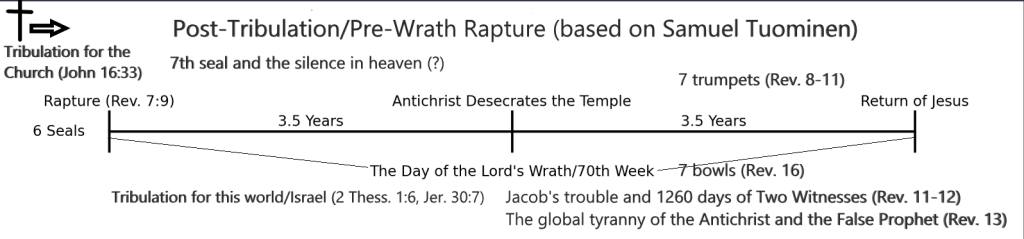
This chart shows that most of the events of Revelation (chapters 8-19) would take place in the second half of the 70th week of the year. Chapter 7 describes the most significant events of the first half of that period:
After this I saw four angels standing at the four corners of the earth, holding back the four winds of the earth so that no wind would blow on the earth, or on the sea, or on any tree. And I saw another angel ascending from the rising of the sun, holding the seal of the living God; and he called out with a loud voice to the four angels to whom it was granted to harm the earth and the sea, saying, “Do not harm the earth, or the sea, or the trees until we have sealed the bond-servants of our God on their foreheads.” And I heard the number of those who were sealed: 144,000, sealed from every tribe of the sons of Israel:
The time of serenity on earth
This gives the clear impression that, between the plagues of the sixth seal and the first trumpet, there would be some kind of temporary state of calm in the land, which God would allow so that the 144,000 saved Israelites could evangelise members of their own nation or the whole world. This strange state of calm could also be put into a wider eschatological context, such as Daniel’s account of the Antichrist bringing about a seven-year covenant between Israel and its enemies or the whole world (Dan 9:27). It would also fit in with Paul’s teaching to the church at Thessalonica that “While they are saying, ‘Peace and safety!’ then sudden destruction will come upon them like labor pains upon a pregnant woman, and they will not escape.”31 In the context of this verse, Paul was talking about the rapture of the church, which “is coming just like a thief in the night” at the time when they say “peace, and safety!”
The Book of Revelation also confirms Paul’s message by describing the multitudes in heaven clothed in white immediately after that moment of deceptive calm is proclaimed on earth. Taking this into account, it would be difficult to fit the rapture of the church into the context of any other event in Revelation. Because it is unlikely that at the moment of the plagues of seals, trumpets or bowls, the inhabitants of the earth would say “Peace and safety”. That time of deceptive calm would also enable the beast and the false prophet to rise to global authority through diplomacy and international treaties, for the beast “was given power over all tribes and nations and languages and people groups”.32
I put a question mark over the seventh seal and the half-hour of silence that follows it, because it is difficult to tell from Chapter 8 exactly when that should be. But time in heaven often moves at a very different pace than on earth (as many of the near-death experiences have confirmed). Therefore, when John mentions the half-hour of silence in heaven following the opening of the seventh seal, that half-hour may correspond to 5 minutes on earth or 5 years on earth. So again, there may be a big temporal gap between the opening of the seventh seal and the blowing of the first trumpet.
Simultaneity of the 7 trumpets and the 7 bowls of wrath
Why don’t I agree with Sami Lahti’s view in his chronology that the trumpets and the bowls of wrath follow each other? Because their simultaneity is clear to me if we parallel the trumpet and cup judgments with each other:
| 1st trumpet: “there was hail and fire mixed with blood, and it was hurled to the earth; and a third of the earth was burned up, and a third of the trees were burned up, and all the green grass was burned up.” | 1st the cup of wrath: “a harmful and painful sore afflicted the people who had the mark of the beast and who worshiped his image.” |
| 2ns trumpet: “like a great mountain burning with fire was hurled into the sea; and a third of the sea became blood, and a third of the creatures which were in the sea and had life, died; and a third of the ships were destroyed.” | 2nd the cup of wrath: “The second angel poured out his bowl into the sea, and it became blood like that of a dead man; and every living thing in the sea died.” |
| 3rd trumpet: “a great star fell from heaven, burning like a torch, and it fell on a third of the rivers and on the springs of waters. The star is named Wormwood; and a third of the waters became wormwood, and many people died from the waters because they were made bitter. | 3rd the cup of wrath: “Then the third angel poured out his bowl into the rivers and the springs of waters; and they became blood. And I heard the angel of the waters saying, ‘Righteous are You, the One who is and who was, O Holy One, because You judged these things; for they poured out the blood of saints and prophets, and You have given them blood to drink. They deserve it.’” |
| 4th trumpet:”a third of the sun, a third of the moon, and a third of the stars were struck, so that a third of them would be darkened and the day would not shine for a third of it, and the night in the same way.” | 4th the cup of wrath: “the fourth angel poured out his bowl upon the sun, and it was given power to scorch people with fire.” |
| 5th trumpet: “a star from heaven which had fallen to the earth… opened the shaft of the abyss, and smoke ascended out of the shaft like the smoke of a great furnace; and the sun and the air were darkened from the smoke of the shaft.” “Locusts” from the smoke tormented unsaved for 5 months. | 5th the cup of wrath: “And the fifth angel poured out his bowl on the throne of the beast, and his kingdom became darkened.” |
| 6th Trumpet: “Release the four angels who are bound at the great river Euphrates… who had been prepared for the hour and day and month and year… so that they would kill a third of mankind.” The number of armies killing people on earth is given as 20,000 x 10,000, or 200 million. | 6th the cup of wrath: “The sixth angel poured out his bowl on the great river, the Euphrates; and its water was dried up, so that the way would be prepared for the kings from the east.” The unclean spirits from the mouths of Antichrist and False Prophet “go out to the kings of the entire world, to gather them together for the war of the great day of God, the Almighty… And they gathered them together to the place which in Hebrew is called Har-Magedon.” |
| 7th trumpet: “there were flashes of lightning and sounds and peals of thunder, and an earthquake, and a great hailstorm.“ | 7th the cup of wrath: there were flashes of lightning and sounds and peals of thunder; and there was a great earthquake, such as there had not been since mankind came to be upon the earth… And huge hailstones, weighing about a talent each, came down from heaven upon people.“ |
Although the judgments are not identical in all respects, we can see from the emboldened texts that they are parallel. For example, the 6th trumpet and the 6th cup of wrath must refer to the same war, because they both begin on the river of the Euphrates and because they both involve the deaths of huge numbers of the earth’s inhabitants. If Sami Lahti’s interpretation that the 6th Trumpet would occur about seven years before the War of Armageddon is correct, then there would have to be at least three world wars causing great global destruction: the War of the Red Horse of the Second Seal, the War of the 6th Trumpet, and finally the Armageddon. With the current weapons of mass destruction, it would be difficult for humanity to recover from even one world war, let alone three. Moreover, the seventh trumpet ends with the following celebration in heaven:
Then the seventh angel sounded; and there were loud voices in heaven, saying, “The kingdom of the world has become the kingdom of our Lord and of His Christ; and He will reign forever and ever.” And the twenty-four elders, who sit on their thrones before God, fell on their faces and worshiped God, saying, “We give You thanks, Lord God, the Almighty, the One who is and who was, because You have taken Your great power and have begun to reign. And the nations were enraged, and Your wrath came, and the time came for the dead to be judged, and the time to reward Your bond-servants the prophets and the saints and those who fear Your name, the small and the great, and to destroy those who destroy the earth.”
If the 7th trumpet were to occur in the middle of the 70th week of the year at the same time that the beast and the false prophet are given power to rule all nations for 42 months, why would the saints in heaven rejoice at that point that “The kingdom of the world has become the kingdom of our Lord and of His Christ?” Would it not be far more fitting that they should rejoice at the end of the beast’s reign, when Jesus Christ is preparing to descend from heaven on his white horse accompanied by an army of white-robed saints? In the middle of the 70th week, the inhabitants of heaven do rejoice for another reason, when war breaks out in heaven and the devil is cast down from heaven to earth. At that time, the great multitude of the saved (the raptured church) already in heaven will praise:
“Now the salvation, and the power, and the kingdom of our God and the authority of His Christ have come, for the accuser of our brothers and sisters has been thrown down, the one who accuses them before our God day and night. And they overcame him because of the blood of the Lamb and because of the word of their testimony, and they did not love their life even when faced with death. For this reason, rejoice, you heavens and you who dwell in them. Woe to the earth and the sea, because the devil has come down to you with great wrath, knowing that he has only a short time.”33
Incorrect timing of two witnesses
And why do I not agree that the 1260 days or 3.5 years of the two witnesses should be in the first half of the 70th week? For three reasons. Their testimony ends shortly before the blowing of the seventh trumpet and above I gave the reasons why the seventh trumpet must occur at the end of the 70th week and not in the middle of it. Secondly, chapters 12 and 13, which also speak of a period of 42 months, 1260 days and three and a half years, also apply to the second half of this week. Sami Lahti also agreed that chapters 12 and 13 deal with the same period.35
Although Sami emphasizes the chronological model of his interpretation in his series of writings, as opposed to its overlapping or parallel explanatory models, his interpretation is not a perfectly chronological narrative either. For if we move from the sixth trumpet to the subsequent period of the two witnesses, and from there to the subsequent 1260-day persecution of the woman (the people of Israel) by the dragon cast to the earth, why do the events of chapter 13 not follow as logically from those of chapter 12? Or why do the bowls of wrath in chapter 16 not follow the end of the 42-month reign of the beast? In other words, why would the trumpets and the bowls have to be sequential events unless the events described in chapters 12 and 13 are equally sequential?
Thus, there is a partial overlap in Sami’s “chronological” interpretations too. And I think it would be much more logical that if the 42 months or 1260 days mentioned in chapters 12 and 13 describe the same period, then equally the 1260 days of testimony of the witnesses mentioned in chapter 11 must refer to this same period. Thirdly, the period of the witnesses must mean the second half of the 70th week because Jerusalem has a temple at that time and the Gentiles trample the holy city for 42 months.36 I have no reason why the construction of the third temple in Jerusalem could not be completed before the middle of the 70th week (I think it is entirely possible that it could be completed a few years before the beginning of the 70th week).
But Jerusalem will not return to the gentiles until the middle of the 70th week. Jerusalem was trodden under foot by the Gentiles from 70 until 1967, as Jesus prophesied in Luke 21: “Jerusalem will be trampled underfoot by the Gentiles until the times of the Gentiles are fulfilled.” Jerusalem is not currentl trampled underfoot by the Gentiles, but will be for those 42 months after the Antichrist desecrates the temple, sends armies against Jerusalem and divides the holy city in two. This is prophesied in the following verses:
- And he will confirm a covenant with the many for one week, but in the middle of the week he will put a stop to sacrifice and grain offering; and on the wing of abominations will come the one who makes desolate, until a complete destruction, one that is decreed, gushes forth on the one who makes desolate.34
- The armies he sends will rise up and desecrate the sanctuary with its fortifications, remove the daily sacrifice, and set there the abomination of desolation.38
- Behold, a day is coming for the Lord when the spoils taken from you will be divided among you. For I will gather all the nations against Jerusalem to battle, and the city will be taken, the houses plundered, the women raped, and half of the city exiled, but the rest of the people will not be eliminated from the city.35
- Therefore when you see the abomination of desolation which was spoken of through Daniel the prophet, standing in the holy place—let the reader understand— then those who are in Judea must flee to the mountains.36
- But the two wings of the great eagle were given to the woman, so that she could fly into the wilderness to her place, where she was nourished for a time, times, and half a time, away from the presence of the serpent. 37
Revelation chapters 11-13 therefore present mainly complementary descriptions of the events of that last 3.5 years in Israel and the Gentile nations. In the same way, the judgments of the trumpets and the bowls are complementary descriptions of the righteous judgments that will befall the inhabitants of the earth and the followers of the beast. Nothing in Revelation requires that the 7 bowls should follow the 7 trumpets. But the trumpets are to follow the 7 seals, for this is made very clear from the beginning of Revelation 8. So the first seal opened by the Lamb and the other three horsemen in chapter 6 does not occur at the end of the 70th week or even at the beginning (the beginning is where the 144,000 sealed Israelites continue to evangelize the world after the church is caught up to heaven in chapter 7 and verse 9). Instead, the first six seals will be opened before the 70th week of the year, as I argued earlier.
Total length of seals, trumpets and bowls in years
So the time from the beginning of Revelation 7 to the end of Revelation 19 is about 7 years, but the time from the beginning of Revelation 6 to the end of Revelation 19 could cover 8, 9, 10 years or more. A time from the opening of the first seal, when the Antichrist rides on the white horse (in imitation of Christ) and makes his diplomatic conquests, to the opening of seals 2 to 6, may take several years. No timetable is given for the events of Chapter 6, so it could be a year or 10 years. And for this reason, I also find it possible that the first seal would have been opened by the time Charles was given the crown (as Revelation 6:2 tells us) at his coronation on May 6, 2023. The next seal describes the great war that will follow:
When He broke the second seal, I heard the second living creature saying, “Come!” And another, a red horse, went out; and to him who sat on it, it was granted to take peace from the earth, and that people would kill one another; and a large sword was given to him.
Since the rider of the red horse “takes peace from the earth”, does this mean that the rider of the white horse, who represents the Antichrist, first gets some kind of peace on earth? Quite possibly. While the outbreak of a world war may be closer than we like to know, it is possible that before a major war breaks out Charles will take on a greater international role and influence, for example as the new leader of the European Union. It will be interesting to see how the possible re-election of Donald Trump as the 47th President of the United States will affect these developments. Will it trigger a backlash from globalists, for example, who want to give the EU and its leader greater international influence?
Clarification again on the Thessalonians
Finally, I will briefly respond to part 10 of Sam’s series where he moved from the Book of Revelation to Thessalonians 2. I already posted a comment on this topic on Sam’s FB page, but the whole article mysteriously disappeared there, so my reply is no longer readable. In the comment, I gave positive feedback on Sam’s coherent and easily digestible argumentation, even though I said I disagreed with his conclusions. To be honest, I have argued this same point so many times that I will not go into detail about my arguments. In short, I do not believe that chapter 2 of 2 Thessalonians provides any more support for post- or mid-tribulationism than it does for pre-tribulationism.
Paul’s teachings on the rapture in both Thessalonians support most the end-time chronology I described above where the Antichrist appears on the world stage first and only then (i.e. months or years later) is followed by the rapture of the church and the 70th week of Daniel 9. Indeed, the pre-tribulationism, that leads its interpretation from Scofield’s reference Bible, teaches the opposite order, that the rapture comes first and only then does the Antichrist is revealed and establish the seven-year covenant with Israel. This order is contrary to the teaching of Paul, who said:
No one is to deceive you in any way! For it will not come unless the apostasy comes first, and the man of lawlessness is revealed, the son of destruction.38
So the chronological order of events is this: apostasy -> the revelation (i.e. unveiling his identity to the church) of the man of lawlessness -> that day. What is the “that day” to which Paul refers? The preceding verse says he was talking about the day of the Lord. And what is the day of the Lord? The preceding verse says it is “the coming of our Lord Jesus Christ and our gathering together to him“. What is our gathering together to Him? The Rapture, according to 1. Thess 4:17. The same thing is clear from chapters 4 and 5 of 1 Thessalonians:
For the Lord Himself will descend from heaven with a shout, with the voice of the archangel and with the trumpet of God, and the dead in Christ will rise first. Then we who are alive, who remain, will be caught up together with them in the clouds to meet the Lord in the air, and so we will always be with the Lord… Now as to the periods and times, brothers and sisters, you have no need of anything to be written to you. For you yourselves know full well that the day of the Lord is coming just like a thief in the night... But you, brothers and sisters, are not in darkness, so that the day would overtake you like a thief; for you are all sons of light and sons of day. We are not of night nor of darkness; so then, let’s not sleep as others do, but let’s be alert and sober.
So what was the Day of the Lord again? It is the day when “we who are alive… will be caught up together with them in the clouds to meet the Lord in the air.” And what event came upon like a thief in the night, according to our Lord? Was it the war of Gog and Magog? The appearance of the Antichrist in the temple? No. It is the coming of our Lord, when “two men in the field; one will be taken and one will be left.”39 And just as Jesus said that day will surprise like a thief the servant who does not watch and who strikes his fellow servants and drinks with drunkards, so Paul said that day will not surprise the children of light, but only the children of darkness. Although we cannot know the exact day and hour of the resurrection40 that does not mean that we cannot be ready on that day, so that it will not overtake us like a thief.
It is therefore highly inconsistent to assume that when Paul spoke of the Day of the Lord in 1 Thessalonians 5, he meant the rapture of the church, but in 2 Thessalonians 2 he would have used the same term to mean something completely different. But was not the day of the Lord also something negative, for ‘then sudden destruction will come upon them like labor pains upon a pregnant woman, and they will not escape.’? Paul was referring here to the people living on earth at the time of rapture, those who will find themselves trapped on earth after the rapture of the Christians. The Day of the Lord in Paul’s terminology may indeed also refer to a time of great wrath that will befall those on earth, but at the same time he makes it clear that such a time will not begin until Christians have been caught up to heaven.41 Below are some questions worth pondering for those who misuse the Thessalonians:
- How can the Paul’s letters to the Thessalonian churches support a post-trib rapture when he said the rapture would take place when people on earth will say “peace and safety?” There is certainly no such time during the trumpets or the bowls of wrath. And why did he repeatedly tell them that the church would be saved from the wrath to come if the church enters into coming wrath? Or why does Paul refer in his letters to the teachings of Jesus in which He compared the coming of Christ to the days of Noah, when Noah’s family was saved in the ark from the flood?42
- If Paul’s letters to the Thessalonian churches supported the mid-trib rapture, why did Jesus say that “of that day and hour no one knows, not the angels of heaven, nor the Son, but the Father alone”? In that case we would be able to count the day of the rapture to the day if it occurred at the same time as the ascension of the two witnesses in Revelation.
- If Paul’s letters to the Thessalonian churches supported the pre-trib rapture (as defined by Scofield’s reference Bible), then why does Paul say that the Day of the Lord, or the rapture of the church, would not occur until after the appearance or revelation of the man of lawlessness. Or if the rapture were to occur without any preceding foreshadowing, then why does Paul say that day would not surprise the children of light like a thief in the night? The thief surprises the sleeping man but the watchful man catches the thief when he enters into house. And spiritually speaking, Christians should be watchful in the night of time, that is, aware of the time in which we live and the signs that point toward the nearness of Jesus’ coming.
- If Paul’s purpose was to reassure the Thessalonian church that they would not be subjected to anti-Christian persecution and tribulation, then why did he boast about their patience and faith “in all the persecutions and tribulations you are enduring”? Or why would Paul have given this false hope to the church at a time when Christians were being taken to be eaten by lions, crucified and subjected to other and inhumane tortures by the pagan Roman Empire? Rather, he was trying to reassure them that they had not missed the day of the coming of the Lord, because the apostasy and the revelation of the man of lawlessness was to precede the rapture. So rather than saying that the Lord could come back at any moment without any premonition, he said these two things would serve as a sign of the time for the rapture of the church. Such premature “at any moment” apocalypsism has fuelled rather unhealthy phenomena and false prophecies in the history of the Church. Paul did not want to encourage such false hopes knowing that the Rapture or the Second Coming was not coming at his lifetime.
- If Paul had referred by removal of the restrainer that restrains the revelation of the man of lawlessness to the rapture of the church, how can the rapture then precede and follow the revelation of the man of lawlessness? Why would Paul have said, “And you know what restrains him now, so that he will be revealed in his time”, unless he was referring to the teaching in the preceding verses that the apostasy precedes the appearance of the man of lawlessness.43 And finally, if apostasy should be translated “departure” in that passage (as a reference to the departure of the church from the world), why is that Greek word apostasia [from which the English word apostasy is also derived] is used in the New Testament only in passages referring departure from the faith? And why do most Bible translations translate it as apostasy if “departure” would be a better translation? And if departure precedes the revelation of the lawless one, how can it at the same time also follow it?
Footnotes
- This standard version is largely based on the early 1900s interpretation of C.I. Scofield’s reference book, which became the standard doctrine of the rapture for many dispensationalists of the 1900s and 2000s, ︎ ↩︎
- Sami writes that the 6th trumpet may also overlap in time with the 3.5 years of the two witnesses: “It is possible that the war of the 6th trumpet and the two prophets overlap partially, completely or not at all. I can find no clear arguments either for or against in the text” (-> Glimpses from Revelation, Part 6 – Is the time of wrath seven years).
↩︎ - Paul mentioned that “the dead shall rise first” before “we who are alive, who are left here, shall be caught up together with them in the clouds to meet the Lord in the air above” (1 Thessalonians 4:16-17). Sami teaches that this resurrection of the dead is described in the context of the fifth seal in Revelation 6:9-11 -> Glimpses from Revelation, Part 1 – Gathering before the throne of God . ︎ ↩︎
- The pre-wrath rapture teaches that the resurrection of the church will take place in the middle of the last 3.5 year period (when the beast will rule the world for 42 months) or before the last seven bowls of wrath where “the wrath of God will be satisfied”) ︎ ↩︎
- Glimpses from Revelation, Part 5 – A time of tribulation or wrath?
↩︎ - See my blog for a more detailed explanation of my critique of Professor Tapio Puolimatkatka’s interpretation of Daniel’s book ︎ ↩︎
- Jeremiah 30:7 and Daniel 12:1 ︎ ↩︎
- Revelation 6:17, 12:2, 15:1 ︎ ↩︎
- Revelation 11:3, 11-15 ︎ ↩︎
- Christianity Is the World’s Most Persecuted Religion, Confirms New Report ︎ ↩︎
- John 15:20, 16:33, 2 Thess. 1:4 ︎ ↩︎
- 2 Thess. 1:4 ↩︎
- 1 Thess. 1:10 ↩︎
- 1 Thess. 5:9 ↩︎
- 1 Thess. 1:6-7 ↩︎
- John 16:33 ↩︎
- Revelation 1:9 ↩︎
- Revelation 2:9, 10, 22 ︎ ↩︎
- Revelation 2:9-10 ︎ ↩︎
- Revelation 3:10 ︎ ↩︎
- Glimpses from Revelation, Part 1 – Gathering before the throne of God
↩︎ - Revelation 5:9-10 ↩︎
- Revelation 1:5-6 ︎ ↩︎
- King James Version translates Rev. 5:9-10 as the elders are speaking of themselves as that group. However, this is a incorrect translation that is not found in most other English (or Finnish) translations of the Bible. You can read more about this here. See also this video about the KJV translation and why it is not the most accurate Bible translation compared to some modern translation such as New American Standard Bible. Here is also illuminating interview about the King James Only Movement. ︎ ↩︎
- Revelation 7:13 ↩︎
- Compare with Revelation 6:9 where persecuted and killed martyrs cried out: “How long, O Lord, holy and true, will You refrain from judging and avenging our blood on those who live on the earth?” ↩︎
- Joel 2:31 ↩︎
- Acts 2:20 ↩︎
- Glimpses from Revelation, Part 5 – A time of tribulation or wrath?
↩︎ - “If we assume that the war, even in the short term, lasts at least six months, and the trumpets 1-4 some months, then we arrive at the point where the church is taken up, for example, a year or more before the beginning of the last 7-year period.” -> Glimpses from Revelation, Part 6 – Is the time of wrath seven years?
↩︎ - 1 Thessalonians 5:3 ↩︎
- Revelation 13:7 ↩︎
- Revelation 12:10-12 ↩︎
- Daniel 9:27 ↩︎
- Zechariah 14:1-2 ↩︎
- Matthew 24:15-16 ↩︎
- Revelation 12:14 ↩︎
- 1 Thess. 2:3 ↩︎
- Matthew 24:40 ↩︎
- Matthew 24:36 ↩︎
- 1. Tess. 1:10, 5:1-10, 2 Thess. 1:6-7 ︎ ↩︎
- 1. Tess. 5:1-5 refers to Jesus’ teaching on the same subject in Matthew 24- ︎ ↩︎
- So by the restrainer, Paul was referring here to either a thing or a person. If it was a thing, then the removal of the restrainer refers to the removal of faith itself. If the restrainer is a person, then it refers to the Holy Spirit, who alone can restrain apostasy and lawlessness. But the causal connection between the removal of the restrainer and the appearance of the person of lawlessness is seen in the fact that the antitype and substitute of Christ can only appear at the time where the apostasy of the Christian churches has made it possible. The interpretation that is associating the restrainer with the Christian church is therefore correct in this sense, but rather than referring to the physical removal of the church from the earth at the resurrection of the church, Paul was referring to its removal in a spiritual sense as a result of its apostasy. For the church faithful to the Word of God is the salt on the earth, which holds back lawlessness, lies and iniquity, but the lukewarm secularised “wokechurch” is the opposite thing that opens the door to the entrance of the Antichrist’s lies and lawlessness. All this has already happened to a large extent in the West, the historical sphere of influence of the Christian Church. So the restrainer has already been removed even though the church is still physically present on earth. ↩︎
 Author & blogger Samuel Tuominen’s archives
Leave a comment