Readers of my books and blog may be familiar with this topic, but I found more light on a question I’ve been pondering for the last 9 years regarding Charles’ Hebrew name. In Revelation 13, there is one key criterion mentioned that any serious candidate for the Antichrist should be able to meet: ‘Here is wisdom. He that hath understanding, let him count the number of the [name of the] beast: for it is the number of man. And his number is six hundred and sixty-six.” In the context of this verse, the beast refers to both the future antichristian world leader and his kingdom, for the beast had “ten horns and seven heads” (the meaning of which is explained in chapter 17) and “opened his mouth to blaspheme God, to mock his name and his tabernacle, those who dwell in heaven.” In chapter 19 we see how this same beast has gathered his army in the battlefield of Armageddon to wage war against Jesus Christ returning from heaven along with the false prophet (the 2nd beast) and they are both thrown alive into the lake of fire.
The first scholar to find Charles’ English and Hebrew name in 666, using the Hebrew-Greek gematria referred to in Revelation 13:18, was an American Messianic Jew named Monte Judah. In the 1980s, Monte Judah built a computer program that adapted the decimal system of the ancient Hebrew and Greek alphabets to the English alphabet and delimited the numerical values according to the 22 Hebrew alphabets, with the smallest value being 1 (א, alef, English A) and the largest value being 400 (ת, tav, English V). Even today, Hebrew can still use Hebrew letters to denote numbers and ancient Hebrew did not use Arabic numerals at all. Another Messianic Jew named Tim Cohen expanded on these Monte Judah studies in his 1998 book The AntiChrist and a Cup of Tea. Cohen’s book stressed, among other things, the connection between the symbolism of the heraldic beasts on Charles’ royal coat of arms (which he wore as Prince of Wales) and the beast symbolism of Revelation 13.
Content
- Eschatological interpretation of heraldry
- The name that counts the number of the beast
- Has the Hebrew name been manipulated?
- Transliteration of foreign names
- A strange dream about the Hebrew name of Charles
- A name that no longer counts the number of the beast
- Probability calculus
- Conclusion
Eschatological interpretation of heraldry
I must point out here that I am not a person who uncritically believes everything that is written on the internet. In my youth, I read articles both in favour of and against the theories in Cohen’s book. And when I finally read his book myself in 2008, I was not entirely convinced by all his interpretations of, for example, royal heraldry, or found them too subjective, although on the whole I found Cohen’s book very interesting, providing a broad basis for his Antichrist theory. But I learned early on not to believe everything I read on the internet. For example, many websites claimed that Queen Elizabeth II had quoted Revelation 13 when she consecrated Charles as Prince of Wales in 1969 at Caernarfon Castle in North Wales.
I was able to easily “fact-check” the falsity of this claim from the transcripts of the liturgy of that 1969 investiture ceremony. The claim was probably based on the fact that Caernarfon Castle was decorated on that day with the banners of the Welsh red dragon and Charles knelt in the ceremony in front of a throne which also had the Welsh dragon emblem engraved on the backrest. However, no passage from the Book of Revelation was quoted during the ceremony, although in Cohen’s book the symbolism of that medieval ceremony was associated with Revelation 13:2:
And the beast that I saw was like a leopard, and his feet like the feet of a bear, and his mouth like the mouth of a lion. And the dragon gave him his power, and his throne, and great authority.
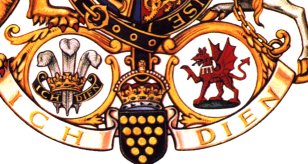
Wales is described by the symbol of the red dragon, and in Revelation that red dragon is the symbol of Satan (Revelation 12:3, 9). The only difference is that the dragon of Revelation had ‘seven heads and ten horns, and seven crowns on his heads’. Interestingly, Charles’ royal coat of arms, which he wore as a mark of his rank as Prince of Wales, also bore seven crowns alongside the red dragon. According to Cohen’s book, Charles’ coat of arms would also have contained a beast that was “like a leopard, and his feet like a bear, and his mouth like the mouth of a lion.” The only problem was that Cohen did not provide proper source data for this claim and based it partly on his subjective interpretation of what he thought the stylised lion-beast on the coat of arms, symbolising England, looked like.

Cohen’s book contained many other rather ambiguous claims, associating the symbolism of the coat of arms with the Antichrist prophecies of the Bible. For example, he associated the unicorn horn, symbolizing Scotland, with the vision of the fourth beast’s little horn in Daniel 7, and claimed that the unicorn had “eyes like the eyes of man” (Daniel 7:8). In my own research, I could only confirm that among historical heraldic scholars and interpreters, the lion-beast of Charles’ coat of arms could also be called the leopard-lion or lion-leopard. In heraldry, lions and leopards do not differ much in appearance and therefore the posture of the beast is the main determinant of whether it is a lion, a leopard or a lion-leopard. But I was unable to find confirmation from neutral sources that the beast of Charles’ coat of arms could be described as a leopard-lion-bear beast as Tim Cohen claimed in his 1998 book.
The name that counts the number of the beast
In the same way, I have also sought to critically examine Monte Judah’s initial claims about the 666 numerical value of Charles’ name. Incidentally, whatever your believe on any matter, it is always very healthy to engage in self-criticism, as it is the only way you can not only better weigh the veracity of your own beliefs, but also respond to counter-arguments before your opponents have even had a chance to utter them. And it also lets you know how well your ideas stand up to criticism. Monte Judah claimed in its articles that Hebrew newspapers had written Charles’ Hebrew name as נסיך צרלס מוילס. This is pronounced “Nasich Charles Me Wales”. Its numerical value in Hebrew gematria, where each letter also stands for a number, can be calculated using the following table:
| Arvo | Letter | The mark |
|---|---|---|
| 1 | Alef | א |
| 2 | Beit | ב |
| 3 | Gimel | ג |
| 4 | Dalet | ד |
| 5 | Hey | ה |
| 6 | Vav | ו |
| 7 | Zajin | ז |
| 8 | Chet | ח |
| 9 | Tet | ט |
| 10 | Jod | י |
| 20 | Kaf | כ, ך |
| 30 | Lamed | ל |
| 40 | Mem | מ, ם |
| 50 | Nun | נ, ן |
| 60 | Samekh | ס |
| 70 | Ajin | ע |
| 80 | Pe | פ, ף |
| 90 | Tsade | צ, ץ |
| 100 | Quf | ק |
| 200 | Resh | ר |
| 300 | Shin | ש |
| 400 | Tav | ת |
Hebrew is read from right to left, so the first letter is nun (נ), which has a numerical value of 50. The next letter is samekh (ס), which is 60. Then follow yod, (י) and kaf (כ, ך), with numerical values of 10 and 20, respectively. This gives the Hebrew word for “prince”, “נסיך”, with a total numerical value of 50+60+10+20 =140. Following the same rule, the whole title “נסיך צרלס מוילס” (Prince Charles of Wales) adds up to 666:
| The mark | Letter | Value |
| נ | Well | 50 |
| ס | Samekh | 60 |
| י | Iodine | 10 |
| ך | Kaf | 20 |
| צ | Tsade | 90 |
| ר | Resh | 200 |
| ל | Lamed | 30 |
| ס | Samekh | 60 |
| מ | Mem | 40 |
| ו | Vav | 6 |
| י | Iodine | 10 |
| ל | Lamed | 30 |
| ס | Samekh | 60 |
| = 666 |
The same name also adds up to 666 in English, when the 26 letters of the English alphabet are matched to this same Greek Hebrew gematria, with the 23rd-26th letter counting as 0.
| Value | English alphabet | Hebrew alphabet | Value of the name |
|---|---|---|---|
| 1 | A | א | P = 70 |
| 2 | B | ב | R = 90 |
| 3 | C | ג | I = 9 |
| 4 | D | ד | N = 50 |
| 5 | E | ה | C = 3 |
| 6 | F | ו | E = 5 |
| 7 | G | ז | C = 3 |
| 8 | H | ח | H = 8 |
| 9 | I | ט | A = 1 |
| 10 | J | י | R = 90 |
| 20 | K | כ, ך | L = 30 |
| 30 | L | ל | E = 5 |
| 40 | M | מ, ם | S = 100 |
| 50 | N | נ, ן | O = 60 |
| 60 | O | ס | F = 6 |
| 70 | P | ע | W = 0 |
| 80 | Q | פ, ף | A = 1 |
| 90 | R | צ, ץ | L = 30 |
| 100 | S | ק | E = 5 |
| 200 | T | ר | S = 100 |
| 300 | U | ש | = 666 |
| 400 | V | ת | |
| 0 | W | ||
| 0 | X | ||
| 0 | Y | ||
| 0 | Z |
The Hebrew alphabet ends in 22 letters and in value 400, therefore the English letters W, X, Y and Z have a numerical value of zero.
Has the Hebrew name been manipulated?
However, as a layman who does not speak Hebrew, I have been a little suspicious for about 10 years about the correctness of the spelling of Charles’ Hebrew name. This spelling was found both in Tim Cohen’s book and in online articles by Monte Judah. This suspicion came over me because in the title of the Hebrew Wikipedia article on Charles (when he was still Prince of Wales), his official title was spelled slightly differently: צ’ארלס ,נסיך וייילס (Charles, Prince of Wales). You will notice the spelling of “prince” (נסיך) is the same as in the Monte Judah version, but the name “Charles” (צ’ארלס) has an extra alef(א) and the name Wales (ויילס) has an extra yod(י) and at the same time lacks the letter mem(מ). In this case, the number value of that name would drop to 637. If you put the name “נסיך צרלס מוילס” in the Hebrew Google search box, a message appears above the search box saying “Did you mean צ’ארלס ,נסיך ויילס?”
I have never doubted or accused Monte Judah of dishonesty, but rather suspected that he made a careless error in his investigations. That is why I sent him a personal letter in 2015 asking him whether, as a Hebrew, he knew something I did not know or whether he had made a mistake. I did not receive a reply to that letter, but Tim Cohen replied to me and said he would address the issue in the second edition of his book The AntiChrist and a Cup of Tea. He swore that the 666 version of the name was correct and the Wikipedia version was incorrect, but never gave any further substantiation of his claim.
So, with no knowledge of the language, I set out to do some research on my own and learnt Hebrew at the same time (just kidding). Here’s what I found out: Monte Judah’s version of that name is not grammatically incorrect and has not been deliberately manipulated to fit in with the number of the beast. But it is an obsolete spelling of that name that is no longer in widespread use. In Hebrew, vowel sounds are not usually marked and it is therefore perfectly normal not to mark the a-sound in the name “Charles”. Therefore, the name can be spelled either צ’רלס, צ’ארלס or צרלס. Nowadays, the two former are more commonly used where the letter tsade (צ), which corresponds to the English sound Ch, is followed by either a niqqud notation above the letter (‘צ) or by a niqqud notation plus the letter alef (צ’א) to better match Charles’ English pronunciation. However, the spelling צ’רלס is just as valid and just as commonly used and does not change the gematrical numerical value of the name.
The Wikipedia version of the title “Prince of Wales”, נסיך וייילס, would most literally translate as “Prince Wales” (without the English of preposition). This is apparently the grammatically correct way to express titles in Hebrew. But if we add the letter mem (מ), מוילס, to the beginning of the name Wales, it then means “Prince from Wales.” Again, this is a perfectly normal and common way in Hebrew of expressing titles such as Prince of Wales. And whether one or two yods are added to the name Wales, or one or two vavs, also varies between Hebrew speakers. In scouring Hebrew language websites, I found it spelled mainly four different ways: ויילס ,ווילס ,וויילס and וילס.
Transliteration of foreign names
It should be noted that both “Charles” and “Wales” are foreign names to the Hebrew speaker, whose pronunciation differs from that of the Hebrew speaker. Therefore, their conversion into another language, i.e. the process called transliteration, is always approximate and not necessarily letter-exact. In Finnish (mother tongue of the writer), we spell foreign names such as Wales according to their original spelling and pronounce them correctly, depending only on the speaker’s level of knowledge of English. If we pronounce the name “Wales” as it is spelt in Finnish, no foreigner would understand what on earth we are talking about. The conversion of nouns into another language in linguistics requires either transliteration or transcription.
This has also been done when Bible translators have converted Hebrew names of persons or places into English. “Yeshua” would be an example of a transliteration of the name of our Lord where the pronunciation of the Hebrew name of Jesus (ישוע) has been tried to be as close as possible to the English spelling and even then the pronunciation does not perfectly match the Hebrew pronunciation of the name. The English form of the name “Jesus” (in Finnish “Jeesus”) would be a better example of a transcription of the name, converting it to a more natural pronunciation of the indigenous language.
One example of this is the now obsolete practice of converting the difficult-to-pronounce names (for us Finnish speakers) of English monarchs, such as Charles, James and George, into the Finnish forms Kaarle, Jaakko and Yrjö. Their pronunciation is far from the English pronunciation of the names, but at least they flow much more easily in the tongues of Finns. The transliterated spelling of those English names would be something like Chaals, Tzeims and Tzoost (I’m open to suggestions if my fellow Finns have better ideas). In this light, you may be able to better understand why Hebrew speakers may spell the name of Wales in Hebrew in slightly different ways.
A strange dream about the Hebrew name of Charles
I happened to find a linguistics forum on the subject, and I was almost going to join in the discussion, but I found that its terms of rules forbid the dissemination and advertising of religious material. On the forum, DonDonDon starts the discussion by asking what the Hebrew letters נסיכצרלסמוילס mean. Another asks why he wants to know and where they come from, to which DonDonDon replies by saying they came to him in a dream. Other German-speaking forum members insist that they mean nothing, but a Hebrew-speaking member soon joins the conversation and replies:
I don’t speak German, sorry. But נסיכצרלסמוילס is actually three Hebrew words spelled out in one word: נסיך צרלס מוילס, or in correct Hebrew הנסיך צ׳רלס מוויילס = Prince Charles of Wales.
Then another asks, “Just out of curiosity (I don’t speak Hebrew), what is the difference between the previous version and ‘correct Hebrew’?”, to which the Hebrew speaker replies, “The previous one was missing the definite article (נסיך = prince, הנסיך = the prince). The letter צ was also not followed by a geresh (apostrophe), which would change its pronunciation from /ts/ to /tʃ/, and מוילס was written according to the old spelling rules (before the spelling reform of the 1960s).” When DonDonDon goes on to ask if the form he is writing is correct according to the older Hebrew grammar rules, another Hebrew-speaking member replies:
This is the spelling used before the reform. Like mußte and daß instead of muss and dass in German. The modern Israeli Hebrew spelling is simplified. The letters ו and י can be vowel or consonant (ו=o, u or v and י=i or y). According to the recommendations of the Hebrew Academy, o, u and i should always be spelled orthographically (in traditional spelling, these vowels were only written when they were etymologically consonants) and the consonants ו and י should be geminate (with a few exceptions). There are a few older people who still use the traditional spelling.
Finally, one of the forum members wonders: “So you saw [the letters] in a dream, and although you are not familiar with Hebrew scripture, you were able to reproduce this text without error. That amazes me.” DonDonDon replies:
I’ve had the image in my head all night. A friend of a friend just told me its value is 666 in Hebrew?????.
This conversation took place in March 2023, a couple of months before Charles’ coronation. Did this person receive a warning in his dream about the man whom the UK would crown as king even though he didn’t know any Hebrew letters? It is of course possible that DonDonDon was already aware of the writings by Monte Judah, Tim Cohen or myself and the Hebrew form of Charles’ name found in them then “haunted” his dreams. But if he was an outsider with no prior knowledge of the subject, then perhaps God is also giving people warning foreknowledge through dreams, so that they will start looking for the right clues. If DonDonDon happens to be reading this post, I would love to hear more about his strange dreams.
A name that no longer counts the number of the beast
If Monte Judah’s version of Charles’ Hebrew name is grammatically correct but out of date, I don’t see it as problematic for the reason that Charles was born in 1948 and in 1958 Elizabeth II gave him his title of Prince of Wales. This was before the spelling reform of the Hebrew language in the 1960s. And this older spelling still appears in some Hebrew news and online publications. However, I would add two main criticisms that a reader might make against this idea: (1) “Prince Charles of Wales” is a title and not a proper name, (2) Charles has a different title today because the title “Prince of Wales” passed to his son William when Charles became King. The first objection is now easily refuted by the fact that the Greek word onoma, used in Revelation 13:17 for the name of the beast, refers equally to royal titles as well. And Royals are not usually known by their first and last names, but by their first name followed by a royal title. Few people would know who Charles Windsor is even though this is effectively Charles’ surname.
The second objection is better than the first, but it is still not enough to argue that Charles is not the beast 666 predicted in Revelation 13. This is because Charles was known for most of his life as the Prince of Wales (from 1958 to 2022). The call in Revelation 13:18 to count the number of the name of the beast is clearly intended for that time, when this person had not yet risen to the anti-Christian position where the beast “was given power to make war against the saints and to overcome them, and all tribes and nations and languages and people were given over to him” (v. 7),
After all, why would anyone need to search for riddles about the names of world leaders anymore in those days, when all God’s saints already know with 100% certainty who the beast is? The task of solving this riddle was clearly given to those saints who did not yet have full certainty of this person’s identity, but who, by following various biblical clues, could obtain more and more corroborating evidence about his biblical identity. Nor have these riddles been given out so that prophetically aware Christians can play detective Sherlock Holmes with them. The omens were given to us so that we could warn the unbelievers who are falling prey to satanic deception – so that we could save at least a few from damnation before they commit the unpardonable sin of worshipping the beast and taking his mark on their right hand or forehead.
What good is it if MacGyver figures out the code to neutralize the bomb at the same moment it explodes in his hands, killing thousands of others in the process? Isn’t that bomb supposed to be defused before it explodes? In the same way, what good would it do for Christians to discover the identity of the Antichrist only at the moment when he has already deceived the whole world at his feet? “Eureka! His name counts to 666!” one “Nostradamus” shouts, and at the same moment agents of the beast break into the home of this “genius” and put a bullet in his skull. It’s too late to start playing Sherlock Holmes at this stage, when the Beast 666 already has absolute power.
Probability calculus
Before I finish, I will briefly explain how I have calculated the mathematical probability of these two coincidences (the 666 of Charles’ name in two different languages). My new friend Ramón Núñez from Spain commented a little on the probability calculations in my English book and suggested that my calculations did not accurately reflect the complexity of the probability calculations. The man is a former professor of mathematics and physics, so his ability to understand complex mathematical equations is light-years beyond my own bird-brain. But I’ll leave rocket science to those wiser than me and explain a fairly simple calculation for readers.
Charles has 20 letters in the English name and 13 letters in the Hebrew name. How do we calculate the probability of 666 for the Hebrew or English name? If you roll the dice and guess the mesh number correctly, the probability of guessing correctly is one in six, because there are six possibilities and only one is correct. Similarly, if your task is to choose a particular letter from the 26 letters of the English alphabet, and pick it out of a mixed box of letters with your eyes closed, the probability of picking the correct letter is one in 26. But what if on the other side of the letter is also written a number corresponding to the numerical values of the Hebrew/English alphabet, and your task was to blindly pick the letters that make up a person’s name, with a total numerical value of 666.
We could think about the question this way: if it is a person’s name consisting of 13 or 20 letters, how many different possible numerical values could they form to know how unusual it is for that name to add up to 666. For example, my first and last name of 14 letters would add up to 1190 in this Hebrew-Greek-English gematria system. Since names can contain the same letter more than once, in probability calculations this task should be performed by the following mathematical equation:

P stands for permutations, n refers to the number of elements (such as letters) that can be selected and r refers to the number of elements selected. That is, if we have 26 letters of the English alphabet to choose from and we have to blindly select 20 letters (so that you can select the same letters more than once), then 26 is only raised to the power of 20, i.e. the number 26 is multiplied by itself 20 times:
2620 = 19928148895209E+28.
Thus, the probability that you will write the name “Charles, Prince of Wales” on a piece of paper and then blindly pull these letters out of the letter box in that order (and return the previous letter to the box again before pulling out the new letter) is one in 19928148895209E+28 (a one followed by 28 other digits). The number 19928148895209E+28 refers to the number of different possibilities you could get by blindly picking up 20 letters from the letter box. What if you pick the right 20 letters, but in the wrong order? For example, you lift the letters “A wolf Charles creeps in”, which is an anagram of the name “Charles, Prince of Wales” and thus also counts as 666. How many different ways can the letters in Charles’ name be rearranged? This is calculated using the following equation:
20! : (2! 1! 2! 2! 2! 3! 2! 1! 1! 1! 1! 1! 1! )
Factorial number 20! in mathematics, refers to the multiplication of positive integers from 20 downwards. So 20! = 20x19x18x17x16x15x14x13x12x11x10x9x8x7x6x5x4x3x2x1 = 2 432 902 008 176 640 000. The factor numbers in brackets are derived from the fact that the name “Charles, Prince of Wales” has 2 C’s, 1 H, 2 A’s, etc. Thus the number (2! 1! 2! 2! 2! 2! 3! 2! 2! 1! 1! 1! 1! 1! 1! 1! ) is calculated as (2×1 = 2) x (1) x (2 x 1 = 2) x (2 x 1 = 2) (2 x 1 = 2) x (3 x 2 x 1 = 6) x (2 x 1 = 2) x (1) x (1) x (1) x (1) x (1) x (1) x (1) = 192. Thus 2,432,902,008,176,640,000 divided by 192 equals 12,671,364,625,920,000. There are so many different ways to rearrange the letters in the name “Charles, Prince of Wales” (and they all add up to 666, since the order of the letters/numbers does not affect the result of the addition). So, if your task is to blindly select 20 English letters with a total value of 666, the probability of success could be calculated as follows:
1 992 814 889 520E+28 : 12 671 364 625 920 000 = 1 572 691 614 796
Update to the article: oops… I think I’m getting my probability calculations and ratios a bit confused here. When calculating the probability, that calculation should be done the other way round: 12 671 364 625 920 000 : 1 992 814 889 520E+28 (number of favourable cases divided by the number of all combinations). Well, the calculation is still not wrong, because the correct answer is still one ratio to 1 572 691 614 796, i.e. one out of 1 572 691 614 796 different possible outcomes.
Thus, the answer to the question of how likely you are to blindly pick 20 letters whose numerical value adds up to 666 is one in 1 572 691 614 796 (about one and a half trillion or one and a half million million). Winning the lottery would be about a million times more likely. You can think of it this way: of the 20 letter combinations, only one combination would count as 666, and of the remaining ones a half trillion possibilities would count as something else entirely (i.e. when all other 666 combinations would be proportional to all the other number possibilities). It would be more likely to get the same number of dice 15 times in a row (the probability of this is calculated by multiplying the number 6 by itself 15 times).
Since the Hebrew alphabet had only 22 letters, of which 13 had to be chosen, the probability of getting 666 is slightly higher. The probability of choosing 13 letters in right order is one in 28281005788308E+17 (= 2213). Whereas the probability of picking up those same letters in any order (but whose total value would be 666) out of 22 Hebrew letters is about one in a billion (you can calculate this in the same way as the previous calculation using factor numbers). Thus, the probability of getting the same number from the same name in two different languages and alphabets is calculated by multiplying the number 1 572 691 614 796 by one billion. This would be equal to 1572691614796E+21, i.e. a probability of 1 in 1500 quintillion (1018). It would be more likely to roll the dice with the same number 27 times in a row (627). Or equivalently: it would be more likely to win the lottery jackpot three times in a row.
To understand the magnitude of these numbers, here is an example of observation: since the estimated birth of our Universe 13.8 billion years ago, just under half a trillion seconds have passed in the history of the world. So it would be more likely to make a computer pick a particular second in those 13.8 billion years and then guess it correctly by chance. Or it would be more likely to divide the distance between the most distant star in the universe and Earth into millimetres and guess the correct distance to the accuracy of millimetre, which the computer would randomly select from those billions of light years.
Conclusion
Revelation 13:8 is just one example of at least 23 individual prophecies in which the characteristics of Charles III match those of the Biblical Antichrist. Determining and calculating the probability of these other coincidences would be so a complicated process that I have not even attempted to calculate it. How do you calculate the probability of, say, the coincidences of Charles being born in the same year as the State of Israel from the same kingdom that ruled Palestine during the reign of his grandfather George VI (as predicted by Daniel in chapter 11 and verses 16-20), or Charles being able to trace his family tree back to both King David and the Prophet Muhammad to fulfill the conditions of the Messiah figure expected by both Muslims and Jews?
Some might argue that in order to be the beast prophesied in Revelation, Charles’ name would have to count as 666 in Greek as well, since Revelation was originally written in Greek for Greek-speaking Christians in Asia Minor. This is not the case, however, because Revelation (and the New Testament) was written in Greek for the sole reason that Greek was to first century Jews what English is to us today. It was the best-known world language of the gentile world at that time, in the same way that English is the most spoken world language in the world today, spoken by at least one and a half billion people as their first or second mother tongue.
For the same reason, it makes sense why the Antichrist should rise from England, the birthplace of the English language, and the country that conquered about a quarter of the world’s continents in the British Empire, the largest gentile empire in history, and the country that published the most widely read and widely distributed Bible translation in history, the King James Bible, which James’ descendant Charles reads to us in the video below.
The devil can cite Scripture for his purpose.
William Shakespeare
An evil soul producing holy witness
Is like a villain with a smiling cheek,
A goodly apple rotten at the heart.
O, what a goodly outside falsehood hath!


 Author & blogger Samuel Tuominen’s archives
Leave a comment