On Wednesday, I watched in shock the brutal execution of one of the most prominent young leaders of America’s MAGA movement, Charlie Kirk, in Utah before hundreds of people. Charlie Kirk was a 31-year-old Christian family man and conservative thinker who had quickly risen to become one of the most recognized young American voices in politics. He founded the organization Turning Point USA and inspired thousands of students to defend constitutional values, freedom of speech, and a Christian worldview. He was also a close friend of President Trump, campaigning for his electoral victories in the 2016, 2020, and 2024 elections.
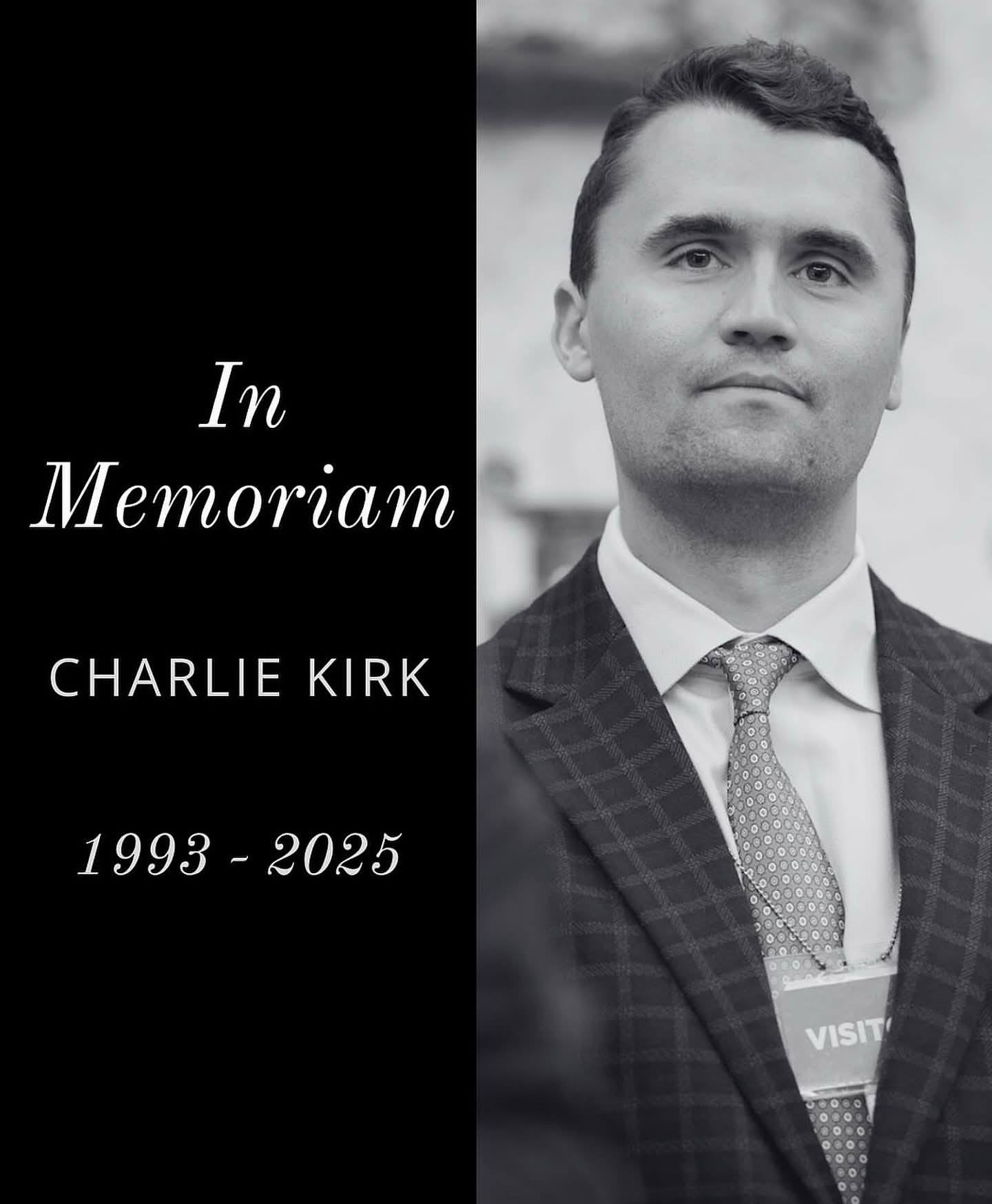
In 2012, Charlie Kirk founded the Republican youth movement Turning Point USA, which annually brings together numerous conservative influencers from around the world. Kirk was especially known for his campus tours, where he challenged a generation of students indoctrinated by radical Marxist professors by defending America’s traditional Christian and constitutional values. He was also one of the most influential advocates of Christian Zionism and Israel in the United States. Thanks to this stance, he succeeded in driving out the so-called groypers—a network of online activists led by the radical Catholic Holocaust denier Nick Fuentes—from the MAGA movement around the turn of the 2020s. These extremist groups promote antisemitism, misogyny, homophobia, and racist ethnonationalism on social media. Since the terrorist attacks of October 7, the far right and far left have once again found common ground in their shared hatred of the Jewish people.
As an evangelical Christian, Charlie Kirk was also known as a friend of apologist Frank Turek, defending for millions of young people the historical truth of the Gospels. His debating style was often direct and sharp, but it was always rooted in love for the truth and respect even for those with whom he strongly disagreed. When he was once asked what motivated him in his work, he replied:
“When people stop talking, very bad things begin to happen. When conversation dries up between spouses, marriages fall apart. When nations lose their ability to dialogue, civilizations collapse into civil wars. When the connection is cut with those we disagree with, violence becomes a much easier option. That is precisely why our culture must restore the honor of conversation—serious, honest, and respectful engagement with differences, where violence is never an option.”
Charlie Kirk was murdered in cold blood as a direct result of the very culture he had warned us against. His beautiful wife Erika and their two small children were forced to witness their loved one’s brutal, public execution. The incident has deeply shocked many commentators on social media—including some who did not share his political views—and even moved them to tears. Yet from the darker corners of the internet and of human nature came voices that either celebrated the murder or responded with cold indifference. I myself received such comments under my published tribute on Facebook:
He was a believer and a conservative! I don’t like those kinds of people.
This is a real day of mourning for the right-wingers. Now you can fantasize about shooting the Greens and others—you’d give them a medal and invite them to the presidential palace. Now the world has one less crazy asshole; I only feel sorry for his children and his wife.
Horror novelist Stephen King, known for his hostility toward America’s MAGA conservatives, initially spread a false claim that Charlie Kirk had called for stoning homosexuals. He was later forced to publicly apologize when it was shown that Kirk had always expressed sympathy toward homosexuals and welcomed them into Trump’s MAGA movement. Lies of this sort—believed by many on the left about American conservatives—are precisely the kind that fuel hatred and inspire some unbalanced individual to take justice into their own hands, believing they are doing humanity a service by shedding innocent blood. As Jesus said, “…the time is coming when anyone who kills you will think they are offering a service to God.” (John 16:2)
It is understandable to feel righteous anger when injustice strikes down innocent and good people. But if Charlie could speak to us today, he would not urge us to answer his murder with hatred or revenge, but with love and forgiveness. Forgiveness does not mean indifference, as if we simply went on with life as though nothing had happened. On the contrary—the deeper the darkness in the world, the more brightly the light and love of Christians must shine. A love that is not only a defense of truth but also the courage to proclaim it even when it may cost us our lives. This love of truth flows from love for our neighbors—even those lost souls whose hearts have been darkened by hatred and who wish to take away those dearest to us.
The name of the youth movement Charlie Kirk founded may yet prove prophetic: his death may mark a turning point in the history of both America and the entire Western world. This will only come to pass if we allow the martyr’s blood to speak to our hearts—calling us to repentance and transformation. That is why it is crucial that we do not answer hatred with hatred, but with love. Love is the only force that can break the cycle of darkness and turn the course of history.
On September 13, a major gathering will be held in London under the leadership of citizen activist Tommy Robinson, where Charlie Kirk’s life and his significant contribution to the conservative and nationalist awakening that has arisen in recent years across the world will be remembered. As Robinson has said, now is not the time to remain silent or fearful, but to rise and speak the truth in love with even greater courage.
Below I include a couple of my own social media posts that received more attention on Facebook than usual. The first one has already gathered over 400 positive reactions and dozens of comments (whereas normally my posts have only ever drawn at best a few dozen).
Charlie Kirk, mourned by millions of Americans as well as his wife and two small children, was an unwavering defender of free speech. He believed that the only way to move beyond the demonization of one’s opponents—and the violence it so often produces—was through open dialogue and honest debate. For him, dialogue was not merely a debating technique, but the very heart of civil society: the opportunity to engage with those who think differently, to learn something new, and to build a shared future.
He was murdered by those who despise Western ideals of liberty and who wish to erect a tyranny where dissenting voices are silenced through fear and violence. At the moment of his death, those who celebrated were precisely the ones who do not believe in the power of free expression to lead society toward a better tomorrow. Charlie Kirk stood and fell upon the hill of free speech. He understood that freedom always carries a cost: when someone imagines themselves more righteous than others, they misuse their freedom of speech to demonize those with whom they disagree; when someone celebrates the death of their enemies, they proclaim that the right to life and free expression belongs only to themselves, and not to those they despise.
Charlie Kirk was the very opposite of such people. He showed by his life that conflict of ideas does not require contempt for other persons, and that debate need not give way to hate. Charlie Kirk was an American legend and a Christian martyr. His cowardly murder will be remembered alongside that of great Christian activists such as Martin Luther King Jr., who paid with their lives for freedom, truth, and justice. May his soul rest in peace in the arms of his Savior, Jesus Christ, in the glory of heaven.
Below is another, more profound social media post of mine, which received less attention:
Charlie Kirk was shot dead in Utah before the eyes of thousands. His beautiful wife Erika and their small children were present and forced, powerless, to witness the bullet strike his neck and blood pour forth uncontrollably. That moment—that shocking image—has been permanently seared into their minds, a memory that may never fade from their dreams or the shadows of their hearts. Only moments earlier they had been a happy Christian family, until the madman’s shot stopped everything and tore their lives apart.
In the face of human tragedy, words often fail. We ask ourselves where God was when the darkness struck. I know that question quite personally, for my beloved older brother Mikael took his own life in December 2020, in the grip of deep depression—just half a year after his first wedding anniversary.
And yet, precisely in such unbearable suffering there can be a mysterious beauty. Tragedy strips us bare and brings out both extremes of our humanity: the merciless and the compassionate. After my brother’s death, I encountered some cold and mocking words, even sneers, from those who laughed at my loss. They looked down on me and my brother as though they knew better how a person should act when the human mind collapses in the valley of despair.
But far more often I experienced the brighter side of humanity. Countless condolences, words of comfort, and kind messages on social media showed that most people, after all, know how to share suffering and show compassion. Tragedy is both ugly and beautiful: it exposes cruelty, but also the deepest humanity. It forces us to face questions we often push aside in the noise of daily life—the finiteness of life, the inevitability of death, and what our existence ultimately means.
A few weeks after my brother’s death, I suddenly experienced an inexplicable moment of joy, freedom, and holy awe. I wanted only to raise my hands and praise God for the greatness of His plans. I cannot fully explain it, but when a person grasps the fleeting brevity of their life against the vast ocean of God’s eternal purposes, one can only bow down in reverence. He is the one who gives life and takes it away. He is the one who on the cross at Golgotha defeated the power of death and bore our sins. When one sees one’s own sinfulness alongside His immeasurable grace and acknowledges His love—the Father’s unconditional love for His children, even when we stray and break His good will—then one understands that not even the darkest moment of suffering can strip away the hope He gives.
The flame of holiness within a person, often smothered by sin and our separation from God, is kindled in the darkest moments, when we ask: “Where is God?” At that moment, we find Him wounded on the cross—the Son of God, lifting His eyes to heaven and crying out in agony and despair:
“My God, my God, why have you forsaken me?”
In the midst of human sorrow and loss, the human heart and human strength are broken so that we may discover that holy flame within us. A flame that can purify us from the hardness of heart and pride to which we are all inclined because of our sinful nature.
The flame can shine only in darkness, and the stars guide the way across the night sky only when all other light is gone. In the same way, in the darkness, hatred, and lovelessness of this world, each of us can shine like the stars of heaven, guiding the wavering ships in the night toward the safe harbor.
Charlie Kirk was such a bright star—one whose life shines forth from the shadows of history to illuminate our own path. His flame burned brightly in the midst of darkness, giving hope to millions and encouraging faith in tomorrow.
His life remains an example to us that through the grace and guidance of Christ we all can strive for something better. His death must not lead us onto the path of vengeance, hatred, and bitterness, for Christ Himself prayed for those who crucified Him. And although the brutal execution of an innocent father stirs in us feelings of righteous anger—especially when many even gloat over it—we must still choose the way of love. When my own brother took his life and people mocked my faith, I too prayed for their souls. Let us now do the same for those who slander Charlie Kirk. For, as Martin Luther King Jr. said:
“Darkness cannot drive out darkness—only light can do that. Hate cannot drive out hate—only love can do that.”
P.S. Although the text was mine, ChatGPT helped shape its expression into something slightly more eloquent.
 Author & blogger Samuel Tuominen’s archives
Leave a comment