Originally published on Facebook on November 18.
I have reflected on how many Christians may approach Christian ethics in a very legalistic way. The Bible is sometimes read as if it were a law book from which individual rules can be picked out and applied to every situation without giving much thought to why those rules were given in the first place or what they are meant to protect.
I do not mean that God’s commandments are irrelevant, or that sin can be excused by appealing to love and good intentions. Quite the opposite. The question is whether we truly understand God’s will if we focus only on the letter of the law while ignoring its moral purpose.
Jesus repeatedly clashed with the religious leaders of his time for precisely this reason.
When the Pharisees criticized him for breaking the Sabbath, Jesus asked which of them would refuse to rescue a sheep that had fallen into a pit simply because it was the Sabbath (Matt. 12:11–12). He was not teaching that God’s commandments could be broken arbitrarily. He was showing that the law can be interpreted in a way that contradicts its original purpose.
“The Sabbath was made for man, and not man for the Sabbath.” (Mark 2:27)
This is a much deeper moral principle than we often realize.
Consider marriage and divorce, for example.
Jesus taught that people should not separate what God has joined together. Marriage is meant to be a lifelong covenant in which spouses commit to loving one another and remaining faithful to one another.
But why does God want marriage to last?
Is it simply that God has given a rule whose violation is sinful regardless of its consequences for people? Or is the purpose of the commandment bound up with the suffering caused by infidelity, abandonment and broken families?
In the book of Malachi, God condemns men who have been unfaithful to the wives of their youth. He says that he hates divorce. The issue is not merely an abstract breach of a rule, but the breaking of a covenant, of trust and of fidelity.
But this leads to a more difficult moral question.
What should a person do if they have already divorced and remarried?
Suppose remarriage was originally contrary to God’s will, as one might conclude from a literal reading of Jesus’ words about divorce and remarriage (Matt. 19:9). Does that mean the person should now leave their current spouse and perhaps break up a family that has been together for years in order to correct their earlier decision? Or could an attempt to undo a past mistake ultimately cause even greater wrong?
In such a situation, does God’s will mean undoing the past at any cost, or rather taking responsibility for one’s current marriage and seeking to live faithfully within it? Would breaking up a new family really be a way of correcting an earlier moral failure that accords with God’s will?
Questions like these cannot be answered simply by picking out a single verse from the Bible and declaring the matter settled.
We need to distinguish between two questions: What should the person have done in the first place, and what should they do now, when their choices have created new obligations to other people?
The same problem arises when a Christian is pressured to remain in an abusive marriage because God hates divorce. But if one spouse is physically, sexually or emotionally abusive, have they not already seriously violated the central moral obligations of marriage? Paul urged husbands to love their wives as Christ loves the church, but very few men manage to do this as perfectly as God would want.
Can defending the sanctity of marriage really mean that a victim of abuse should submit to ongoing mistreatment?
And what does the Bible teach us about people whose lives did not conform to God’s original ideal for marriage?
Abraham had Hagar as well as Sarah, and had a son, Ishmael, with her. Jacob had several wives and children with different women. David, too, had several wives.
In a modern Christian congregation, men like these might find themselves in quite a serious meeting with the elders. Yet Abraham is called God’s friend and presented as an example of righteousness through faith.
This does not mean that the Bible presents polygamy as God’s original ideal for marriage. The Law of Moses warned kings against acquiring many wives (Deut. 17:17), and in the New Testament Paul emphasizes the importance of monogamy, particularly for church leaders (1 Tim. 3:2).
At the same time, we need to understand that God’s revelation and his plan for humanity have unfolded gradually through history. In the ancient world, polygamy was an established practice in many societies, and God did not require its immediate abolition in every situation. Instead, he could work within the imperfect social structures of the time and gradually guide people toward his original purpose.
This does not mean that God is a moral relativist or that right and wrong change arbitrarily with the culture. Rather, it means that God takes humanity’s historical circumstances, understanding and incompleteness into account. He does not always require people to meet, all at once, everything his ultimate will entails.
Jesus himself referred to this principle when he explained that Moses permitted divorce because of the people’s hard hearts, even though it had not been so from the beginning (Matt. 19:8).
God’s original purpose does not necessarily change, even if the way he guides fallen humanity toward that purpose may differ from one age to another.
Another interesting example is Rahab, who earned her living as a prostitute.
In the book of Joshua, Rahab hid the Israelite spies and lied to the men searching for them about where they were. Yet James holds her up as an example of someone whose faith was shown through righteous actions (James 2:25).
Imagine a similar situation in Nazi Germany in 1942. You are hiding Jews in your home, and an SS officer comes to ask whether you have concealed them there.
Which would be the morally right thing to do: tell the truth and put innocent people in danger of death, or lie and save their lives?
This does not mean that lying is generally acceptable. Moses specifically prohibited it in the ninth commandment. But the example shows how moral obligations can come into conflict, and how applying them mechanically can lead to an outcome completely contrary to what the moral law was meant to protect.
Rahab’s story does not by itself settle every question about the morality of lying. But it at least gives us reason to ask whether an action’s moral character can be judged separately from its purpose and circumstances.
Jesus criticized the Pharisees for observing religious rules meticulously while neglecting what mattered most in the law:
“Justice, mercy and faithfulness.” (Matt. 23:23)
I believe this is one of the central teachings of Christian ethics.
God’s commandments are not arbitrary orders whose only purpose is to test how obediently a person can follow them. They also express God’s goodness and justice, and his desire to protect people from evil.
That is why Christians should learn to ask not only what the Bible commands or forbids, but also why it commands or forbids it.
What good does this commandment protect? What evil is it meant to prevent? And have I really understood God’s will if applying my own interpretation of Scripture harshly leads only to more suffering, injustice and rejection of my neighbour?
This is not a call to moral relativism. It is a call to moral wisdom.
Paul writes:
“Love worketh no ill to his neighbour: therefore love is the fulfilling of the law.” (Rom. 13:10)
And perhaps most important of all, acknowledging our own sinfulness does not mean approving of sin. It means understanding that we, too, need the same grace of God that we are so quick to measure out to others.
A Christian’s task is not to take God’s place and pass final judgment on people. It is to seek to understand God’s will and to live it out in truth, love and humility.
Sometimes a person can become so focused on defending the letter of God’s law that, in the process, they violate the very principles the law was given to protect.
This also connects to the age-old debate about whether we have the right to judge one another.
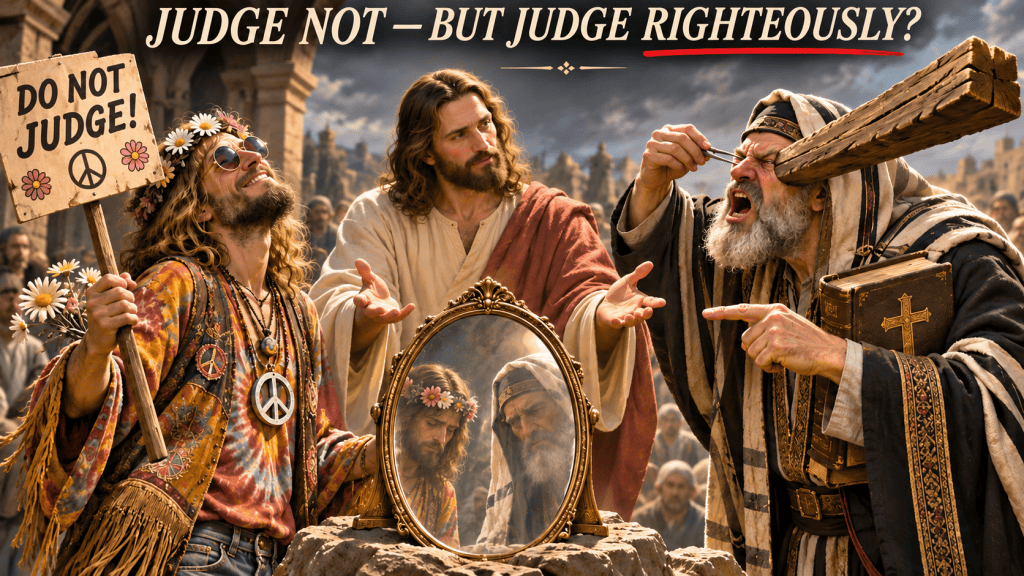
Some of us quote Jesus’ words “Do not judge” as if we were hippies from the 1960s: “Let a thousand flowers bloom! Peace and love!”
Others pick out individual verses from the Bible to condemn everyone but themselves for one thing or another. For them, the Bible is more like a law book that can be used to show how wrong everyone else is.
In my view, neither extreme does justice to the Bible’s overall teaching.
When Jesus said in the Sermon on the Mount, “Judge not, that ye be not judged” (Matt. 7:1), he did not mean that we should give up all moral discernment or uncritically accept everything people do.
In the same passage, Jesus spoke of someone trying to remove a speck from their brother’s eye while failing to notice the plank in their own. But it is worth noticing that Jesus did not say to leave the speck in their brother’s eye forever. He said, “First cast out the beam out of thine own eye; and then shalt thou see clearly to cast out the mote out of thy brother’s eye” (Matt. 7:5).
In other words, Jesus did not forbid moral judgment. He condemned hypocritical and arrogant judgment.
In the Gospel of John, he says: “Judge not according to the appearance, but judge righteous judgment” (John 7:24).
There is no contradiction between these teachings once we understand their context.
We should be able to distinguish right from wrong, while also recognizing that we are not infallible judges entitled to place ourselves above other people.
It is one thing to assess a person’s actions, words or teachings. It is another to pass final judgment on their human worth, the motives of their heart or their standing with God.
And this brings us back to why the Bible should not be read as a collection of verses taken out of context.
Again and again, the stories in the Bible show how easily people see the sins of others while remaining blind to their own. The Pharisees were often very strict about other people’s religious and moral conduct, but Jesus exposed their own hypocrisy. At the same time, Jesus did not teach that sin was meaningless or that all moral choices were equal.
So this is not a choice between two extremes: either we condemn everyone, or we are not allowed to judge anything.
Christian morality includes both the ability to distinguish good from evil and the humility to acknowledge that we can be mistaken.
And perhaps we should remember one more thing: even if we are right about something, that does not automatically mean we should make ourselves the personal judge of everyone we meet.
Not every mistake needs to be corrected in public, not every provocation needs an answer, and not every disagreement needs to become a five-day theological trial in the Facebook comments.
Sometimes loving our neighbour means daring to tell them a difficult truth. At other times, wisdom means knowing when it is better to remain silent.
Defending the truth and constantly proving that we are right are not the same thing.


Leave a Reply