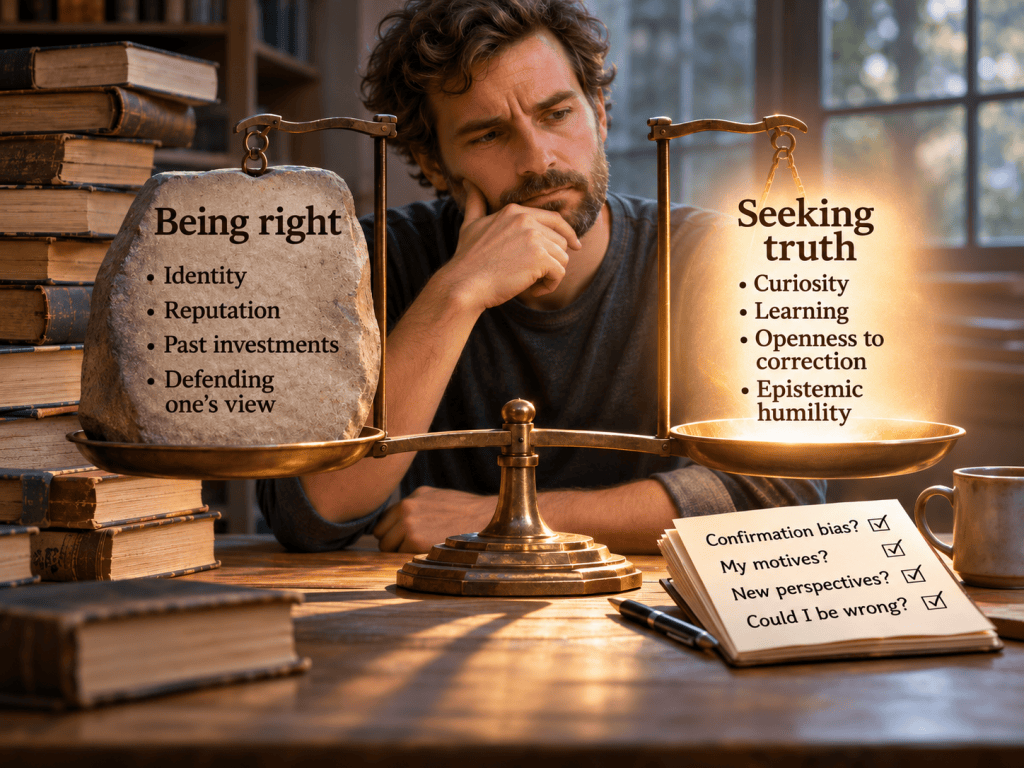
Epistemic humility, identity, and the freedom to seek truth.
I recently wrote a blog post entitled When Being Wrong Can Be a Blessing. I have since been reflecting on a related question: why can it be so difficult for us to admit that we were wrong about something, even when acknowledging our mistakes would greatly benefit our intellectual development? Why do we sometimes devote enormous amounts of mental energy to defending our previous conclusions instead of welcoming the opportunity to understand reality better?
I believe one of the main reasons is our tendency to make our beliefs part of our identity. When we identify ourselves with a particular philosophical, political, or theological conclusion, questioning that conclusion begins to feel like a personal attack. We are no longer merely defending our ideas; we are defending our understanding of who we are.
Do Not Make Your Conclusions Your Identity
I have personally sought to address this problem by making the process of investigation, rather than its conclusions, part of my identity.
Instead of defining myself as someone who believes that King Charles III is the Antichrist, I define myself as someone who investigates whether Charles III could be the Antichrist. Instead of defining myself as someone who believes that Jesus will return in 2040, I define myself as someone who investigates the possibility that Jesus could return in 2040.
The distinction may sound like mere semantic hair-splitting, but its psychological significance is considerable.
If my identity is based on the outcome of my research, proving that outcome wrong represents a personal failure. If my identity is based on the process of investigation, demonstrating that one of my conclusions was mistaken represents progress in my research.
In the former case, I have a personal interest in being right. In the latter, I have a personal interest in discovering whether I have adequately considered all possible perspectives in my research.
I can still regard a particular hypothesis as well-founded and defend it with strong arguments. Epistemic humility does not mean that we should have no strong convictions. It means being willing to abandon even our strongest convictions when better evidence and arguments warrant doing so.
Our Past Must Not Own Our Future
The more time, money, reputation, and personal effort we have invested in a particular belief, the more difficult it may become to abandon it. If I have written several books on a subject and devoted twenty years of my life to investigating it, I may feel that discovering my conclusions were wrong would invalidate my entire life’s work. From a human perspective, such a reaction would be entirely understandable.
But why should we think this way?
If, after twenty years of research, I ultimately succeed in disproving my original hypothesis, I will still have learned an enormous number of things along the way that I would not otherwise have learned. The value of my research does not depend exclusively on whether my original assumption proves correct.
Nor does being a researcher have to be my permanent identity. Today, I am a researcher of biblical eschatology and an author. In the future, I could become a plumber if, for some strange reason, I suddenly became more enthusiastic about plumbing than theology.
I am under no obligation to believe tomorrow everything I believe today, nor am I obliged to spend the rest of my life doing what I have done thus far.
Our previous choices should not become a prison that prevents us from growing, learning, and discovering new directions in life.
The Pursuit of Personal Glory as an Obstacle to Truth
In the seventh chapter of John’s Gospel, Jesus presents an interesting insight into the relationship between knowing the truth and human motivation:
He that speaketh of himself seeketh his own glory: but he that seeketh his glory that sent him, the same is true, and no unrighteousness is in him. (John 7:18, KJV)
In the same Gospel, Jesus asks:
How can ye believe, which receive honour one of another, and seek not the honour that cometh from God only? (John 5:44, KJV)
These words contain a profound epistemological and psychological insight. Jesus identifies the pursuit of personal glory as an obstacle to accepting the truth.
A person may have access to an enormous amount of information, but if their primary motivation is to defend their position, reputation, or authority, they can easily begin to select and interpret that information in ways that serve their own interests.
The purpose of investigation is then no longer to discover what is true, but to find new arguments for what one has already decided to be true.
In psychology, this tendency to seek, interpret, and give greater weight to information that supports our existing beliefs is known as confirmation bias. Intellectual honesty requires acknowledging that this tendency affects all of us, myself included. Merely being aware of confirmation bias does not make us immune to it, but it helps us examine our own thinking more critically.
Epistemic humility requires us to love truth more than we love being right. For Christians, this should also mean that knowing God’s truth matters more to us than preserving our own theological authority.
Our Human Worth Does Not Depend on Being Right
I believe the Christian understanding of human nature provides an excellent foundation for this kind of freedom. My worth as a human being does not depend on how intelligent I am, how much I know, how many books I have written, or how accurate my conclusions have been. My worth is grounded in the fact that I was created in the image of God.
I do not, therefore, have to earn my worth by being right.
Understanding this can liberate us from an enormous psychological burden. I can admit that I was wrong without having to regard myself as less valuable, less intelligent, or less loved by God.
Perhaps one of the deepest forms of intellectual freedom is the ability to approach our own beliefs with curiosity rather than possessiveness. My ideas are not possessions that I must defend against other people. They are attempts to understand reality and, as such, remain open to correction and new insights.
The epistemic principle by which I would like to live my life is this:
I want to remain faithful to the truth, not to the conclusions that my pursuit of truth has led me to thus far.
The text was written with the help of AI.


Leave a Reply