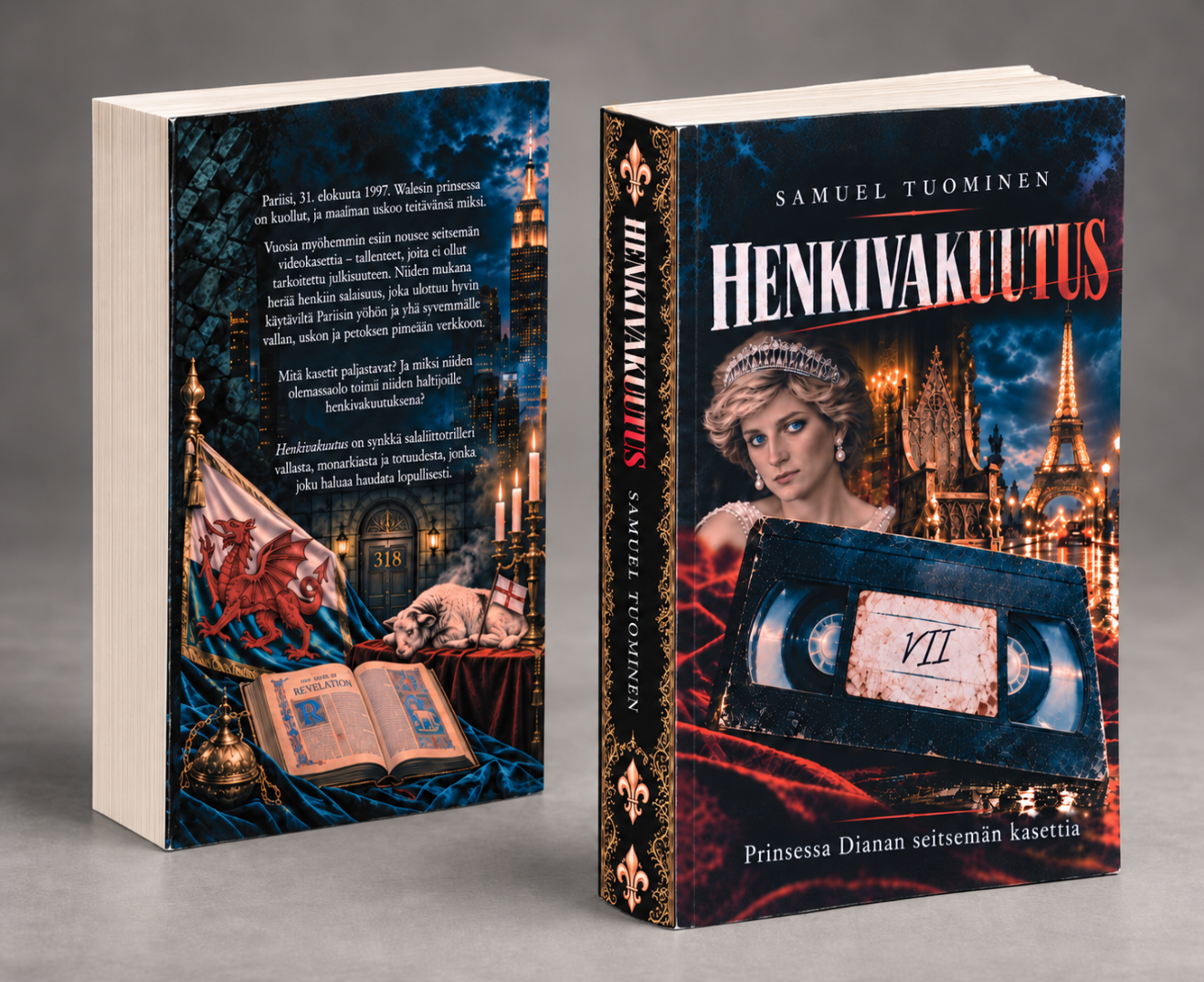
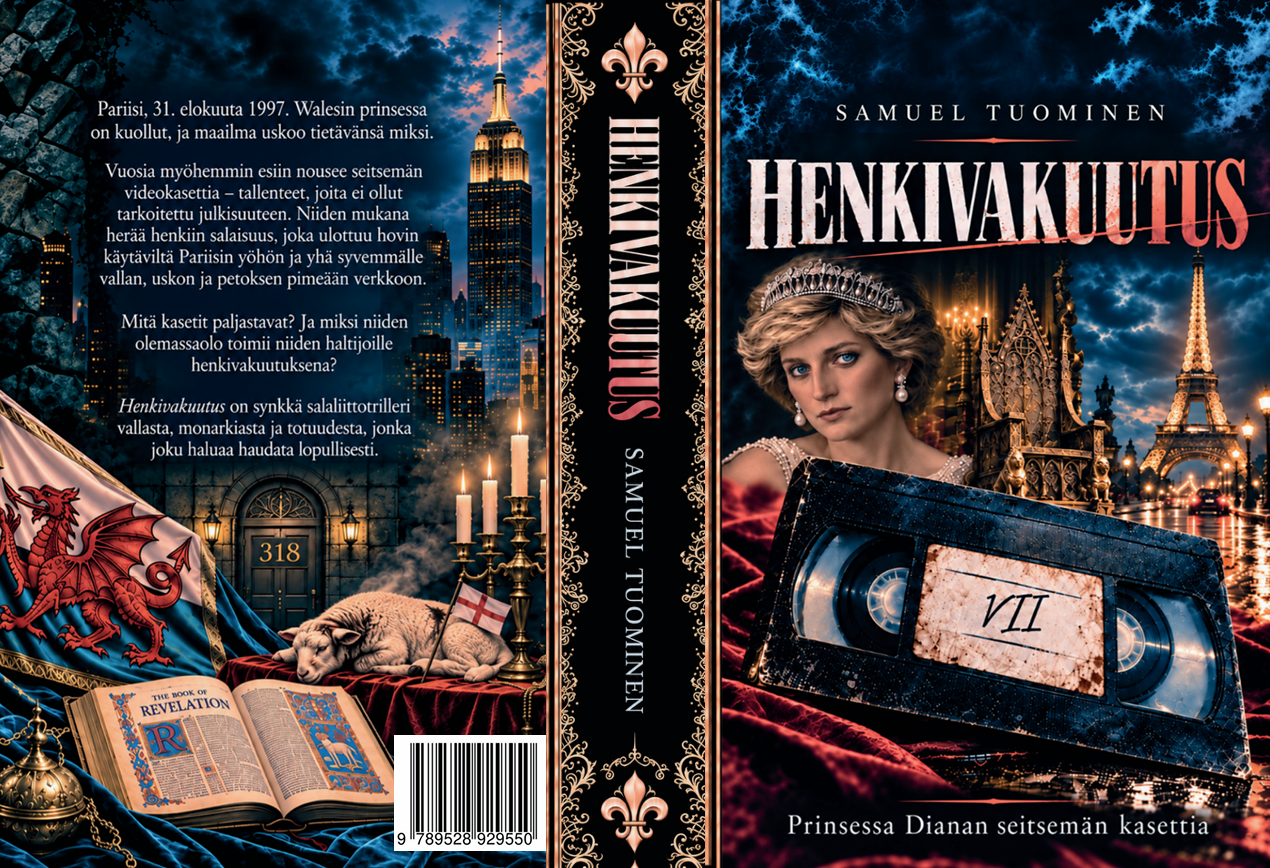
Things have been a little quiet on my blog over the past few weeks, as I have been busy writing my first novel. The book runs to 636 pages and is titled Henkivakuutus – Prinsessa Dianan seitsemän kasettia (Life Insurance – Princess Diana’s Seven Tapes). Although I wrote the novel largely with the help of AI, it still took 40 days to complete. At first, the pace was fairly brisk, and I might write two or three chapters a day. Toward the end, things slowed down as I had to work out a satisfying resolution to the story.
One problem with writing a novel is that, as the story draws in more and more mysteries, the author can soon become so tangled up in them that even he can no longer find a way out. In a good thriller, its mysteries should unfold for the reader little by little. But if new ones keep appearing as the story progresses, the author himself may soon start wishing someone could explain the plot of his own novel to him.
Things become especially tricky when a detail introduced early in the story has to fit with something revealed hundreds of pages later. Nor is it enough for the ending to explain everything that has happened before. It also has to feel believable, rather than as though the author has pulled a new character or a secret document out of a hat in the final chapter to solve every problem by magic.
I particularly enjoy endings in which the reader realizes that the decisive clues have been right in front of them all along. They simply could not grasp their significance until the final pieces of the story fell into place. At its best, an ending sends the reader back through the earlier events in their mind, thinking: of course—that is how it had to happen!
Although the story of my novel is fictional, it is largely grounded in real history. The events take place between 1997 and 2004 and center on the death of Diana, Princess of Wales, in Paris on August 31, 1997. In the novel, historical facts, real people, documented events, and newspaper headlines become intertwined with an imagined conspiracy, behind which something much larger gradually begins to emerge.
For the book, I had to study Diana’s life, her relationship with the British royal family, and the circumstances of her death in considerable detail. Among other things, I examined the timeline of events in Paris, eyewitness accounts of the crash, intelligence agencies’ methods, and the subsequent police investigations. The historical details mattered because I wanted the fictional plot to be as convincing as possible within the framework of real events.
To me, one of the most fascinating things about a conspiracy thriller is that the reader does not always know where historical reality ends and the author’s imagination begins. A seemingly unbelievable detail may be based on a real document or eyewitness account, while an entirely plausible event may be wholly invented.
At the same time, I wanted to avoid a problem common to conspiracy fiction. If the conspiracy is run by an all-powerful organization that controls every intelligence agency, police force, media outlet, and political leader in the world, the story can easily begin to lose credibility. It is much more interesting to portray a limited group of people trying to use existing power structures to further their own ends. In that situation, not everyone involved necessarily knows what cause they are really working for.
Writing the novel was therefore a constant balancing act between historical accuracy and literary imagination. Real events set the boundaries of the story, but between them lay plenty of room for questions to which a fictional narrative could offer answers of its own.
This is my first novel, and its prose was written by AI. That does not mean, however, that I asked ChatGPT to write a book and then went off for a nap. Although AI was largely responsible for the actual wording, planning the plot, characters, events, and ending required a considerable amount of thought on my part. In practice, I acted as the novel’s screenwriter and director, while AI turned the scenes I had planned into literary prose.
In other words, I did not ask AI to write a 636-page conspiracy thriller. I built the narrative one chapter and one scene at a time. I often gave it quite detailed instructions about what should happen in a scene, how the characters should behave, and what information could be revealed to the reader at that point. I then evaluated the resulting text, changed dialogue, corrected inconsistencies, and, when necessary, had entire scenes rewritten.
AI—or “superintelligence,” as President Trump’s administration officially renamed it while I was writing this book—can produce some quite interesting prose. Its weaknesses become more apparent in long-form storytelling. You cannot set AI to work on a story this complex without constant human guidance, selection, and editing. The writing process therefore felt more like an ongoing conversation between two screenwriters than automated text generation.
The experience also made me reflect on what authorship really means. Is an author primarily the person who forms the sentences and chooses the words, or the person whose imagination gives rise to the world, characters, and events of the story? In traditional novel writing, these tasks have usually belonged to the same person. In the age of AI, however, they can be separated.
I am not claiming that working this way replaces the craft of a traditional novelist. Rather, it is a new way of creating literature. In my case, it enabled me to move from nonfiction into fiction without first having to master all the finer points of writing novelistic prose. It did not, however, relieve me of a storyteller’s most important responsibility: ultimately, to tell the reader an engaging and coherent story.
A note for English-speaking readers: I aim to translate the book into English as well before the end of 2026, provided no problems arise with the publication of the Finnish edition.
Author Samuel Tuominen


Leave a Reply