Ever since Donald Trump was elected President of the United States just over ten years ago, I have been a very public defender of him and his MAGA movement. Even after his supporters besieged the Capitol on January 6, 2021, and Joe Biden entered the White House as the 46th president, I predicted that Trump would serve a second presidential term, as indeed he did. The Republicans lost the November 2026 midterm elections, but this is by no means historically unusual, nor can it yet be taken as a prediction of what will happen in the 2028 presidential election.
I still view President Trump favorably, and the midterm results have not changed my position at all, because I do not base my opinions on whichever party or political ideology happens to be popular or in power. Trump’s war with Iran was thought to be a major reason for the Republican defeat, which is quite understandable: war is never a popular party-political cause, even when it is morally justified or necessary and prevents a much greater catastrophe.
But the Republican defeat seems to have emboldened both the far left and the far right in the United States and elsewhere in the Western world. Their existing narrative was that President Trump’s administration was somehow on a leash held by Israel and Benjamin Netanyahu, and that Trump was supposedly putting Israel’s interests ahead of America’s own. This is, of course, a historically illiterate narrative, since President Trump has quite consistently supported the removal of Iran’s Shiite clerical regime since the 1980s and warned of the catastrophic consequences of Iran acquiring a nuclear weapon with which it could hold the entire free world hostage.
There is nothing new about the Marxist-influenced far left hating Western civilization, capitalism, Israel, and their Judeo-Christian foundations. This red-green alliance between Islam and Marxism has been recognized in academic historical research for decades, and it was also a major force behind the anti-Shah Iranian Revolution of 1978. What has surprised many Christian conservatives, myself included, however, is the rise of hatred toward Jews in “Christian” right-wing circles in recent years. This may not yet be as visible in Finland, but in the United States the phenomenon is known as the rise of the so-called woke right, whose most prominent spokespeople have included former MAGA supporters such as Candace Owens, Tucker Carlson, and Nick Fuentes.
For example, as recently as the 2024 presidential election, Tucker Carlson was a major supporter of President Trump and campaigned for his victory. Today he frequently hints that President Trump might be the beast 666 of the Book of Revelation. Some have speculated that the demon which, according to Tucker himself, once attacked him in the middle of the night eventually took possession of him, and that this is why he is now known as America’s most dangerous antisemite.
Now the same woke right has spread to Britain as well. Calvin Robinson, who was excluded from the Anglican Church a few years ago because of his conservative views, has for years been a popular Christian leader among patriotic British Christians who oppose their country’s growing Islamization and the erosion of Christian values. I came across my blog post from March 2023, before Charles’s coronation, in which I praised Calvin Robinson as “a true warrior of God” and included a link to his speech at the University of Oxford.
Today my opinion of him is very different. The same applies to Tucker Carlson, whom I regarded as one of the most important conservative voices until the end of 2024, even though signs of his turn to the dark side were already apparent during that year. Likewise, conspiracy theorist Alex Jones, whom I followed back in the 2000s and who was one of the original supporters of the MAGA movement, playing a key role in Trump’s victory over Hillary Clinton in the presidential election ten years ago, is now known as a spokesman for this woke right. In April 2026, President Trump published a Truth Social post in which he denounced Jones, Carlson, Owens, and company as “low-IQ fools” in his characteristically Trumpian manner.
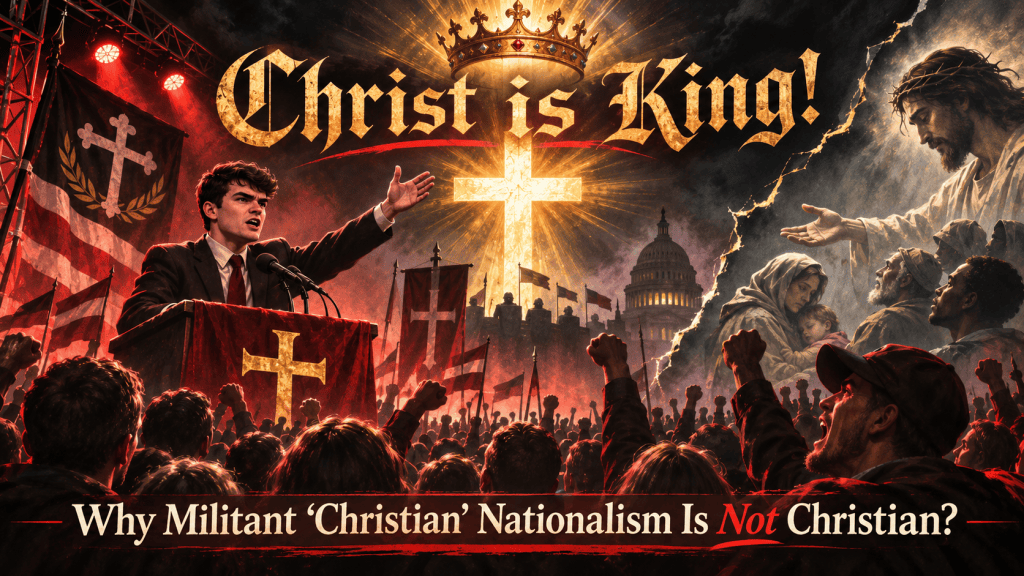
Calvin Robinson recently attended the Christ Is King: America After Trump conference in Texas. Alongside Alex Jones, its speakers included Holocaust denier Nick Fuentes and Joel Webbon, a pastor and political extremist who spoke against racial equality and called for America to remain a white country. Webbon has also expressed radically misogynistic views and supported repealing the Nineteenth Amendment to the U.S. Constitution—in other words, revoking women’s right to vote. On his X account, Calvin Robinson proudly posed alongside Nick Fuentes, and in one interview he said outright that America should expel all Jews from the country. As I said in my X post below, this is not Christianity but old medieval anti-Jewish bigotry dressed in Christian garb.
At the conference, many speakers began whipping up the audience with militant battle cries of “Christ is King! Christ is King!” I agree with those who say that this violates the third commandment given through Moses: “Thou shalt not take the name of the LORD thy God in vain; for the LORD will not hold him guiltless that taketh his name in vain.” I asked AI about this, and according to its response, the commandment could also be translated from the original Hebrew as: “Do not bear the name of the LORD your God falsely or for a wrongful purpose.” In other words, someone who proudly displays Christ’s name or Christian symbols is not automatically the most devout and courageous follower of Jesus. A person may proudly shout “Christ is King” amid the increasingly anti-Christian climate of our times, yet do so out of pride and hatred toward their neighbor.
And the Christ Is King movement is a textbook example of precisely this. Its supporters do not seem particularly concerned about where their neighbors will spend eternity. When they speak about Jews, they are not grieved that they have not yet recognized their Messiah. To them, Jews are primarily political enemies and killers of Christ. For them, “Christian” is not a name for a forgiven sinner but a label for an identity group.
This is also why they are generally not very ecumenically minded: they may even treat other Christians with hostility unless those Christians share their political views or belong to a Christian tradition they approve of. Christian unity then ceases to rest on a shared faith in Jesus Christ and instead rests on a shared image of a political enemy or a shared ecclesiastical tradition.
Christianity thus gradually becomes a kind of tribal religion in which what matters most is no longer what Christ has done to save sinners, but who belongs to our group and who is against us. The cross of Christ is no longer primarily a symbol of atonement and forgiveness; it is turned into an emblem of one’s own cultural and political identity.
This is particularly ironic because Jesus himself confronted precisely this kind of religious nationalism in his own day. Many of his contemporaries expected a Messiah who would liberate Israel from Roman rule and restore the political power of the Jewish people. Jesus, however, refused to become that kind of Messiah, whose task would have been to defeat national enemies. Instead, he commanded his followers to love their enemies and pray for those who persecuted them.
Paul, in turn, expressed his own attitude toward unbelieving Jews in the ninth chapter of Romans by saying that he felt great sorrow and unceasing anguish in his heart for them. He even said he was willing to be separated from Christ himself if that could save his people. Such was the apostle’s attitude toward those who did not acknowledge Jesus as their Messiah.
How far removed this is from the spirit in which people demand the expulsion of Jews from Western countries in the name of Christ’s kingship!
The message of Christianity is not that we Christians are inherently better people than Jews, Muslims, atheists, or adherents of any other worldview. Its message is that we are all sinners and need the same grace. If Christianity is used to justify one’s own national, ethnic, or political superiority, the central message of the gospel has been turned upside down.
As a sociopolitical phenomenon, the rise of the woke right is, in itself, a perfectly understandable development. As Christians are marginalized in our increasingly secular and anti-Christian society, this awakens in many believers a natural desire to fight back: to defend our faith and society’s crumbling Christian moral foundations. Ironically, however, the woke right is undermining the very Judeo-Christian foundations on which the West was built.
Nor is it a coincidence that many of them are already disparaging the term “Judeo-Christian.” History has shown time and again that when Christianity is severed from its Hebrew roots, society has often drifted into antisemitism, spiritual arrogance, and a form of religious nationalism that turns Christianity into an instrument of national or ethnic superiority. It is then easy to forget that Christianity did not arise as a product of European civilization, but as a faith centered on a Jewish Messiah, whose first apostles and preachers were Jews.
Attempts to detach Christianity from its Jewish foundations appeared even in the early Church. Marcion, who lived in the second century, for example, rejected the God of the Old Testament and sought to distinguish the God revealed by Jesus from the God of Israel. Although the Church condemned Marcionism as heresy, anti-Jewish interpretations took root in Christian thought in later centuries, portraying Jews collectively as the murderers of Christ and as a people eternally rejected by God.
The historical consequences of these ideas were sometimes devastating. The persecution of Jews in the Middle Ages, forced conversions, and expulsions show how easily a Christian religious identity could be used to justify conduct that flagrantly contradicted Christ’s own teachings.
We do not even need to appeal to modern human rights thinking to recognize this contradiction. We need only open the eleventh chapter of Romans, where Paul explicitly warns Gentile Christians against boasting at the expense of Jews:
“Boast not against the branches. But if thou boast, thou bearest not the root, but the root thee.” (Romans 11:18)
Paul, then, did not urge Christians to despise Israel because of its unbelief, but warned them against spiritual pride. He also reminded them that God has not rejected his people whom he foreknew (Romans 11:1–2).
In this light, it is quite remarkable that some of the political activists who proclaim Christ’s kingship most loudly seem to regard Jews as an enemy people rather than as the people from whom their own Savior, their apostles, and the entire history of biblical revelation emerged.
A Christianity that begins to despise its own roots is in danger of losing its understanding of what it ought to be. For this concerns much more than Christianity’s Jewish roots alone. The central ideals of Western society include human dignity, justice, freedom of conscience, and the idea that an individual’s worth does not depend on social status, ancestry, or membership in a particular ethnic group. These ideals have developed through a long historical process in which Christian theology, ancient philosophy, Roman law, and the Enlightenment have all influenced one another.
From a Christian perspective, however, their foundation can be seen above all in the biblical understanding of humanity: human beings are created in the image of God. Not only Christians, white people, or Westerners, but every human being. That is precisely why defending Christian civilization cannot mean returning to a social order in which citizens’ basic rights are determined by their sex, ethnic origin, or religious identity. Such a system might well call itself Christian, but its Christianity would be questionable, to say the least.
This does not mean that Christianity should be absorbed into modern liberalism or that all the values of contemporary Western society are automatically biblical. A Christian can quite consistently oppose, for example, secularization, moral relativism, and the systematic sidelining of the Christian cultural heritage. But if the proposed antidote is ethnic nationalism, religious coercion, and the collective blaming of entire groups of people, we risk replacing one ideological extreme with another.
And here, in my view, lies the most tragic paradox of the entire woke right: it claims to defend Christian civilization, yet may simultaneously abandon the very Christian moral principles that have made that civilization worth defending. For the hallmark of a Christian society is not how loudly its citizens shout that Christ is King, but how seriously they take his teachings.
For if Christ truly is King, then his commands to love one’s neighbor and one’s enemy apply precisely to those who acknowledge him as their King. Christ’s kingship cannot credibly be defended by despising the people for whom Christ died.
And finally, as Christ himself answered Pilate, who ordered his crucifixion: “My kingdom is not of this world: if my kingdom were of this world, then would my servants fight, that I should not be delivered to the Jews: but now is my kingdom not from hence.” (John 18:36). The woke right often forgets this as it tries to enthrone Christ as king over the kingdoms of this world.
Part of this blog post was generated with the help of AI. The English translation was also prepared with AI assistance.


Leave a Reply