The King’s younger brother, Andrew Mountbatten-Windsor, who was known as Prince Andrew until November 2025, was arrested on his 66th birthday after Epstein documents released by President Trump’s administration revealed new evidence against Andrew for abuse of public office. The arrest was not directly related to the allegations made by the late Virginia Giuffre, who claimed she had been trafficked by Jeffrey Epstein to be sexually abused by Andrew on three separate occasions. The arrest warrant instead concerned evidence that he had shared confidential trade information with Jeffrey Epstein, a convicted sex offender, while serving as the United Kingdom’s Special Representative for International Trade and Investment from 2001 to 2011.
The arrest of Andrew Mountbatten-Windsor marks the first time a member of the British royal family has been arrested since 1647, when Charles I was detained and later sentenced to be beheaded at the end of the English Civil War. This illustrates the extraordinary degree of legal immunity the institution has historically enjoyed. Although the United Kingdom is a constitutional monarchy where the monarch does not rule as an absolute sovereign, he nevertheless stands, in practice, above the law. The King cannot be charged with any crime in his own courts, because the British legal system operates formally in his name: all criminal prosecutions are brought in the name of the Crown, and the King himself is the Crown as a legal person.
The traditional principle “The King can do no wrong” does not mean that the monarch is morally infallible, but rather that he cannot be prosecuted in his own courts, since he is their legal source. If Charles III were to shoot a man in broad daylight in front of one hundred witnesses, it would not be legally possible to arrest him or bring him to trial. That is how matters stand de jure. However, de facto, such a scenario would naturally lead to public outrage and demands for the King’s removal, at which point Parliament and the democratically elected Prime Minister would have the authority to initiate a political process forcing the monarch to abdicate or declaring him unfit to rule. Afterward, he could also be arrested and charged, because other members of the royal family do not enjoy the same legal immunity.
The legitimacy of the Crown ultimately rests on parliamentary consent — the Bill of Rights of 1689 emerged from precisely such a situation, when one monarch was deposed and replaced by another. The monarchy does not exist as a law of nature, but by virtue of parliamentary will. In practice, however, a king could commit murder and still retain his crown if the crime were carried out in secrecy, witnessed by only a few individuals too afraid to testify, and if the police were reluctant to investigate evidence pointing to the monarch, since even the possibility would threaten the stability of the monarchical system.
Britain’s medieval aristocratic class structure, rooted in deference to the monarch, also protects other members of the royal family. A serious crime committed by a prominent royal would constitute a public scandal difficult for the monarch to escape, as many would begin to ask whether the monarch himself had been aware of the crime or involved in covering it up to protect the institution’s reputation. For this reason, it can plausibly be argued that the royal family has, for centuries, stood above the law or at least been treated according to different legal standards than ordinary subjects. The system is designed to protect monarchical governance, and the aristocratic order ensures that many individuals at the top of society hesitate to criticize the monarch or his family for fear of jeopardizing their own status.
This dynamic was clearly demonstrated in the arrest of Andrew Mountbatten-Windsor: the King’s brother’s arrest was the result of over fifteen years of sustained public pressure on the royal family, sparked by Virginia Giuffre’s allegations and legal actions, which first gained widespread media attention fifteen years ago. This chain of events ultimately led to Jeffrey Epstein’s arrest and alleged suicide in 2019, as well as Prince Andrew’s infamous BBC interview, in which he attempted to defend himself against Giuffre’s accusations but only appeared more guilty due to his implausible and at times absurd alibis, which were widely mocked by journalists and commentators in both the press and on social media.
However, Andrew’s arrest would not have occurred without the release of three million Epstein documents (with another three million still unreleased). This disclosure was part of President Trump’s campaign promises, and many Americans voted for him on that basis. At the same time, many have expressed frustration at what they see as evidence of efforts by Trump and his administration to sweep the scandal under the rug and continue protecting influential pedophiles. Thus, the legitimacy of the United Kingdom’s monarchy is now being shaken as a consequence of American democracy, which speaks volumes about the inability of Britain’s own parliamentary system to challenge abuses of power by its ruling elites.
As noted above, the involvement of a senior royal family member in a serious crime undermines the legitimacy of the entire monarchy, as many now ask how much Charles knew about his brother’s misconduct and whether he was involved in concealing it. For example, in 2022 the royal family paid Virginia Giuffre £12 million, of which £10 million reportedly came from Elizabeth II and £2 million possibly from the Prince of Wales, although the King now seeks to deny this.
For many Britons, this civil settlement appeared to be an admission of guilt, since an innocent person would not yield to blackmail but would instead fight false accusations in court. Defenders of the monarchy argue that it was a routine risk-management decision intended to avoid negative media attention during the Queen’s 70-year jubilee celebrations. Nevertheless, from an optics standpoint, it appears to many as an attempt to conceal Andrew’s crimes and silence victims at the highest levels of power.
Many are now speculating that the remaining three million Epstein documents have not yet been released because they may contain sensitive information about other members of the royal family. It must be remembered that the United Kingdom and the United States share a special relationship, their intelligence services cooperate closely, and President Trump is a well-known Anglophile and admirer of the monarchy. As someone who has generally viewed President Trump favorably, I have often criticized his statements praising the British monarchy. I consider it entirely possible that the Trump administration has sought to downplay the Epstein scandal and continue its concealment, because its revelations could potentially threaten the survival of the British monarchy itself.
At times, I have promoted QAnon-type conspiracy narratives on my blog suggesting that Trump was engaged in some kind of secret war against the British monarchy (Trump’s own tweets occasionally lent support to such interpretations). However, his public statements praising Charles III make such a conclusion difficult to sustain. The crisis involving the King’s brother has been described in the international press as the country’s worst royal crisis since the abdication of Edward VIII in 1936, who was known for his Nazi sympathies.
The current situation, in which a senior royal is under investigation and in police custody, is without precedent and presents the monarchy with its greatest threat since 1936, when Charles’s great-uncle, King Edward VIII, abdicated the throne in order to marry the American divorcée Wallis Simpson.
“This is certainly the most serious crisis since the abdication, and it is particularly difficult because it is not a crisis they can truly control,” said a former senior palace aide who knows the King well.
“They have been on the defensive the entire time, because they have had to react to emerging information, and they still do not know what else may be revealed in the documents,” the aide told Reuters anonymously.
Many media reports are now openly discussing the possibility of Charles III’s abdication if the royal scandal involving his brother deepens further. One royal commentator stated on Fox News that she would not be surprised if the crisis ultimately led to the King’s abdication. The video report below by Dan Wootton suggests that Charles could transfer the crown to William within the next six months, with the official justification being the King’s health struggles with cancer, while the real reason would be to preserve the face of the monarchy, since William, the current Prince of Wales, has not been tainted by his uncle’s alleged misconduct in the same way as His Majesty the King.
If the scenario presented by Wootton were to come true, what would it mean from the perspective of my eschatological interpretations? As readers familiar with my work know, I have followed the royal family closely for over 20 years and have written three books (two in Finnish, the first of which was never published, and one in English) in which I expanded upon the theories advanced in the 1990s by the Americans Monte Judah and Tim Cohen, who identified the then–Prince of Wales, Charles, as the most likely candidate for the role of the biblical Antichrist.
From the very beginning of my writing career, however, I have acknowledged that this is merely a hypothesis that only time would ultimately prove either true or false. Since early 2014, when the media reported on Charles III’s cancer diagnosis, I have been somewhat more cautious in these predictions and have sought to focus more on other subjects that interest me, such as transhumanism, which I also addressed in my most recent book, Aadam 2.0 vai Peto 6.66 – Transhumanismi Raamatun valossa (Adam 2.0 or Beast 6.66 – Transhumanism in the Light of the Bible, Books on Demand, December 2024). Nevertheless, my position has remained consistent: Charles III remains, at present, the most likely candidate for the role of the biblical Antichrist, if probability is defined according to the numerous biblical criteria associated with this individual, criteria which Charles is able to fulfill more literally than any other living public figure.
These criteria are defined in my book Joka ei ollut saapa kuninkaan arvoa – Antikristus paljastettu? (Books on Demand, January 2019), its English-language counterpart To Whom the Majesty of Kingship Has Not Been Conferred – The Antichrist Revealed?, published in May 2022, as well as in my 2018 blog article, 27 Independent Reasons Why I Believe Prince Charles Is the Antichrist. Of course, I acknowledge that when we speak of the fulfillment of biblical prophecy, we are always dealing with matters open to interpretation, and therefore it is impossible to say in a completely objective sense that this or that individual fulfills a given prophecy more literally than others.
But when I speak of biblical criteria for this individual, I refer, among other things, to criteria such as the Book of Daniel indicating that this person would be both a prince and a king.
And the people of the prince who is to come will destroy the city and the sanctuary [i.e. Prince Titus of the Romans who destroyed Jerusalem and its temple in 70 A.D.] And its end will come with a flood; even to the end there will be war; desolations are decreed. And he [that is, the aforementioned coming prince] will make a firm covenant with the many for one week [at this point the vision shifts to the end-time Antichrist, who initiates the final week, and he is typologically associated with the ‘coming prince’ mentioned in the previous verse—that is, the Roman prince, which the title ‘Prince of Wales’ etymologically signifies], but in the middle of the week he will make sacrifice and grain offering cease; and on the wing of abominations will come one who makes desolate, even until a complete destruction, one that is decreed, is poured out on the one who makes desolate.”— Daniel 9:27, Legacy Standard Bible
And in his place a despised person will stand, to whom the splendor of the kingdom has not been given, but he will come in a time of ease and take hold of the kingdom by intrigue. — Daniel 11:21, LSB
Both of these passages, which have been identified as prophecies concerning the final Antichrist in Arthur W. Pink’s classic 1922 work The Antichrist, require that the Antichrist occupy a royal role as a prince to whom the honor of kingship was not willingly given by his people, because he was a despised heir to the throne (which, according to opinion polls conducted in Britain, was clearly true in the case of Charles III, whom many Britons did not wish to become king). Yet according to the same verse, he would nevertheless obtain the kingdom through intrigue or cunning. The same idea is repeated in Daniel chapter 8:
In the latter period of their reign, When the transgressors have run their course, A king will stand, Insolent and skilled in intrigue. His power will be mighty, but not by his own power, And he will destroy to an astonishing degree And succeed and do his will; He will destroy mighty men and the holy people. And through his insight He will cause deceit to succeed by his hand; And he will magnify himself in his heart, And he will destroy many while they are at ease. He will even stand against the Prince of princes, But he will be broken without hands.— Daniel 8:23–25, LSB
Then the king will do as he pleases, and he will exalt and magnify himself above every god and will speak astonishing things against the God of gods; and he will succeed until the indignation is finished, for that which is decreed will be done. — Daniel 11:36, LSB
These prophecies clearly present the Antichrist’s dual role as both prince and king, and that he would first be a prince and then a king. Could this refer to some king other than Charles III? Certainly. But the point is not that these would be the only biblical criteria by which I have identified Charles III as this individual. If the criteria were limited solely to the person’s role as prince and king, then he could just as well be Prince William (although William, unlike his father, is not a despised heir, as Daniel 11:21 appears to require) or any other crowned ruler.
But would my theory concerning Charles III collapse if the King were to abdicate his throne, as his great-uncle Edward VIII did? Not necessarily. There is a prophecy in the Book of Ezekiel concerning the Antichrist that could be interpreted as referring to a king who relinquishes his crown. Arthur W. Pink also associated this passage with the future Antichrist in his eschatological study more than a century ago.
And you, O slain, wicked one, the prince of Israel, whose day has come, in the time of the iniquity of the end, thus says Lord Yahweh, ‘Remove the turban and take off the crown; this will no longer be the same. Make high that which is low and make low that which is high. A ruin, a ruin, a ruin, I will make it. This also will be no more until He comes to whom the legal judgment belongs, and I will give it to Him.’ — Ezekiel 21:30–31, Raamattu Kansalle translation.
This prophecy originally referred to Zedekiah, the last king of Judah during Ezekiel’s lifetime. It foretold the fall of the Davidic monarchy, which would not be restored until “he comes whose right it is; and I will give it to him.” This person is, of course, Jesus Christ, the King of Israel and rightful heir of the house of David (Matt. 1:20; 2:6; 27:42), who will one day rule the millennial kingdom. However, Pink interpreted this as a typological reference also to the future Antichrist, who would appear as a prince of Israel—that is, as a false messiah to the Jewish people:
When we turn to the Prophets there the references to this Monster of Iniquity are so numerous that were we to cite all of them, even without comment, it would take us quite beyond the proper bounds of this introductory chapter. Only a few of the more prominent ones can, therefore, be noticed….
In Ezek. 21:25-27 we read: “and thou, profane wicked prince of Israel, whose day is come, when iniquity shall have an end, Thus saith the Lord God; Remove the diadem, and take off the crown: this shall not be the same: exalt him that is low, and abase him that is high. I will overturn, overturn, overturn it: and it shall be no more until he comes whose right it is, and I will give it him.” The dispensational place and scope of this passage, is not hard to determine. The time-mark is given in v. 25: it is “when iniquity shall have an end.” It is the End-Time which is in view, then, the End of the Age, when “the transgressors are come to the full” (Dan. 8:23 and cf. 11:36 — “Till the indignation be accomplished”).
At that time Israel shall have a Prince, a Prince who is crowned (v. 26), and a Prince whose day is said to be come when “iniquity shall have an end.” Now, as to who this Prince is, there is surely no room for doubt. The only Prince whom Israel will have in that day, is the Son of Perdition, here termed their Prince because he will be masquerading as Messiah the Prince (see Dan. 9:25)! Another unmistakable mark of identification is here given, in that he is expressly denominated “thou, profane wicked Prince” — assuredly, it is the Man of Sin who is here in view, that impious one who shall “oppose and exalt himself above all that is called God…
The Profane and Wicked Prince of Israel here can be none other than the Antichrist, for we are expressly told that “his day shall be when iniquity shall have an end.” The reference is, of course, to Israel’s “iniquity,” and their iniquity shall end at the appearing of the Messiah (see Dan. 9:24) when “He shall be a priest upon His throne” (Zech. 6:13). Here in Ezekiel we see how the Son of Perdition shall ape the Christ of God, for he, too, will be a priest-king: “Remove the diadem” refers to the insignia of his priesthood (in every other place in the O. T. where this occurs the Hebrew word here translated “diadem” it is rendered “mitre” — worn only by the high priest of Israel); “take off the crown” is the symbol of his kingship…
“And thou, O deadly wounded Wicked One, the Prince of Israel, whose day is come, in the time of the iniquity of the end; thus saith the Lord: remove the mitre, and take off the crown” (R. V.). This is clearly Israel’s last king, ere the King of kings and Lord of lords returns to the earth. He is here termed “the Prince of Israel” as the true Christ is denominated “Messiah the Prince” in Dan. 9:25. The description “O deadly wounded Wicked One” looks forward to Rev. 13:12, where we read, “The first Beast whose deadly wound was healed!” “Remove the mitre and take off the crown” point to his assumption of both priestly and kingly honors. The Heb. word for “mitre” here is in every other passage used of the head dress of Israel’s high priest! Finally, the statement that his “day is come[hellip]in the time of iniquity of the end” establishes, beyond a doubt, the identity of this person.
How, then, does this prophetic criterion apply to Charles III? The modern State of Israel is not a kingdom but a republic; yet it began as a mandate territory under the United Kingdom (a circumstance which, in itself, is foretold in Daniel 11:16–20, where the kings preceding the Antichrist are described as ruling the land of Israel). Israel therefore has no prince or king. But Charles III—who was born in the same year as the State of Israel, who was circumcised by a Jewish mohel, and who possesses an unofficial genealogical chart claiming that he is the legal heir of the house of David—can, at least in principle, present himself as fitting the Ezekielian criterion of a “prince of Israel.”
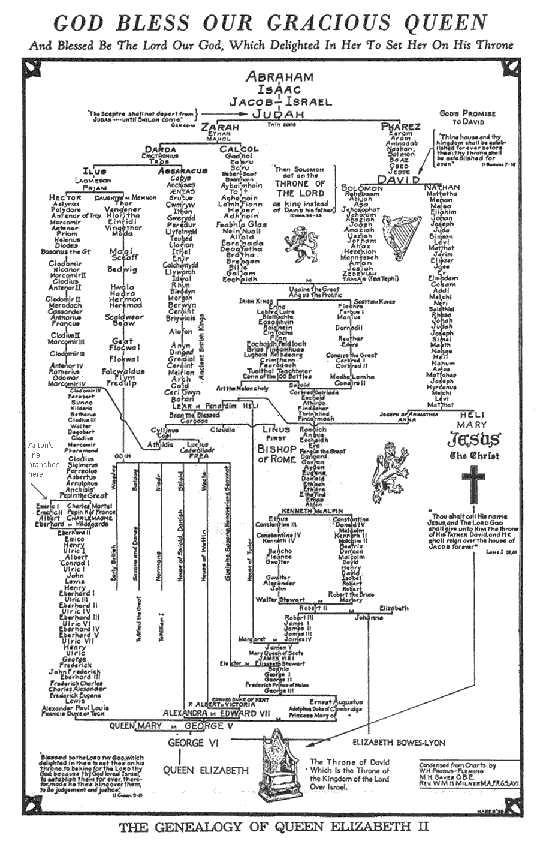
Charles III can thus be argued to satisfy Ezekiel’s criterion of an “Israelite prince” because he can claim descent from the same royal line as King Zedekiah. One possible reason this figure is not called the “king of Israel” in the passage is that no one will be crowned King of Israel prior to Jesus Christ’s return to Jerusalem. This would also align with the original framework of Ezekiel 21:30, according to which the fallen Davidic crown would not be given to anyone until “he comes whose right it is”—the one to whom the crown legally belongs. Before that, the “profane and wicked prince of Israel” may indeed claim that crown for himself, but it is not granted to him.
As Pink emphasized, Ezekiel 21:30’s reference to the turban and the crown points to the Antichrist’s dual status as both royal and priestly. Charles III is not only King of the United Kingdom and head of state of fourteen other Commonwealth realms; he is also the nominal head of the Church of England—the Anglican counterpart to the Pope. Yet Ezekiel’s warning stands: “Thus says the Lord God: Remove the turban, take off the crown! Things shall not remain as they were.” Could this be a prophecy of Charles III’s abdication? If this individual were what Paul called the “man of lawlessness” (2 Thess. 2:3), abdication could not signify retirement, but rather a transformation—from king into something else, perhaps even into a would-be “king of kings.” In his present role, Charles is bound by constitutional limits he cannot openly challenge without endangering his own crown.
After relinquishing the throne, Charles could begin pursuing a far more political international role. It is even conceivable that he might be offered the title of king or prince in some other context, given his global reputation as a kind of “climate king” concerned for the planet’s future. One possibility is “Prince of Transylvania,” a title reportedly offered to him by a local mayor in 2017, since Charles III is said to descend directly from Romania’s Vlad III—known as “the real Dracula of Transylvania” and one of the most sadistic rulers in European history. Another possibility would be “Prince of Greece”—a title his father, Prince Philip, carried before marrying Elizabeth II, since Philip was born into the Greek branch of the House of Glücksburg, which once ruled Greece.
A third option would be even more dramatic: Charles VIII, ruler of a revived Holy Roman Empire. This may sound implausible, since the empire has not existed since 1806, when Napoleon Bonaparte dissolved that thousand-year polity—whose rulers were often crowned by the Pope as heirs of the Western Roman Emperors, most famously Charlemagne and Charles V. Yet one month after Charles III ascended the throne, Brendan Simms—Professor of the History of European International Relations at the University of Cambridge and Director of the Centre for Geopolitics—proposed such a concept in complete seriousness in an article titled, Charles III—Why Don’t We Make Him Europe’s King-Emperor? Europe has problems, and Britain has drifted away from Europe. Here is an idea, a historical experiment. It is a Star Wars solution. Crown Charles III as Charles VIII, Emperor of Europe.
But the question is this: could any arrangement of this kind plausibly become reality while Charles remains the reigning monarch of the United Kingdom? Would he need to relinquish his present crown in order to receive another in its place? The Book of Revelation speaks of the dragon and the beast bearing seven and ten crowns. In his current role, Charles III cannot yet be identified in every respect with the beast of Revelation, even if his former title—Prince Charles of Wales—can be argued to calculate to the number of the beast, 666, both in English and in Hebrew. His current title does not yield the number of the beast, which means a new role might also enable a new title—and thus a renewed numerological connection to 666.
But is time already passing him by? I am the first to admit that the King’s advancing age and his struggles with health are making him an increasingly implausible candidate for the role of the Antichrist. And yet, at the same time, he remains the most plausible candidate at the present moment. It is possible that I have come to my watchtower at the wrong time, and that the Antichrist is not destined to appear for many decades. For even if I argue that Charles III is currently the most credible candidate, I cannot claim with certainty that some other figure will not arise in twenty or thirty years who fulfills the biblical criteria even more fundamentally.
My main critique is directed at lazy hermeneutics—where every remotely suspicious political figure is speculated to be the “man of lawlessness” without first studying the history of biblical eschatology, the texts of the Church Fathers, or attempts like those of Arthur W. Pink to approach the subject through systematic theology, textual context, and a comprehensive analysis of prophetic parallels—precisely the approach I have tried to adopt before I began denouncing anyone as the Prince of Darkness.
 Author & blogger Samuel Tuominen’s archives
Leave a comment